
Should You Convert to a Roth IRA? 5 Reasons Yes, 5 Reasons No
A Roth IRA conversion is one of the most talked-about planning strategies, and one of the most misunderstood. The idea is simple. You move money from a tax-deferred account, like a traditional IRA or old 401(k), into a Roth IRA. You pay income tax on the converted amount now. In exchange, that money and its future growth can come out tax-free later.
Whether that trade makes sense depends on you: your tax brackets now and later, your health, what you want to leave behind, and where the money to pay the tax will come from. A conversion that works well for one family can be an expensive mistake for another.
Here are five reasons a conversion may make sense, and five reasons it may not.
5 Reasons to Consider Converting
1. You Have an "Opportunity Valley"
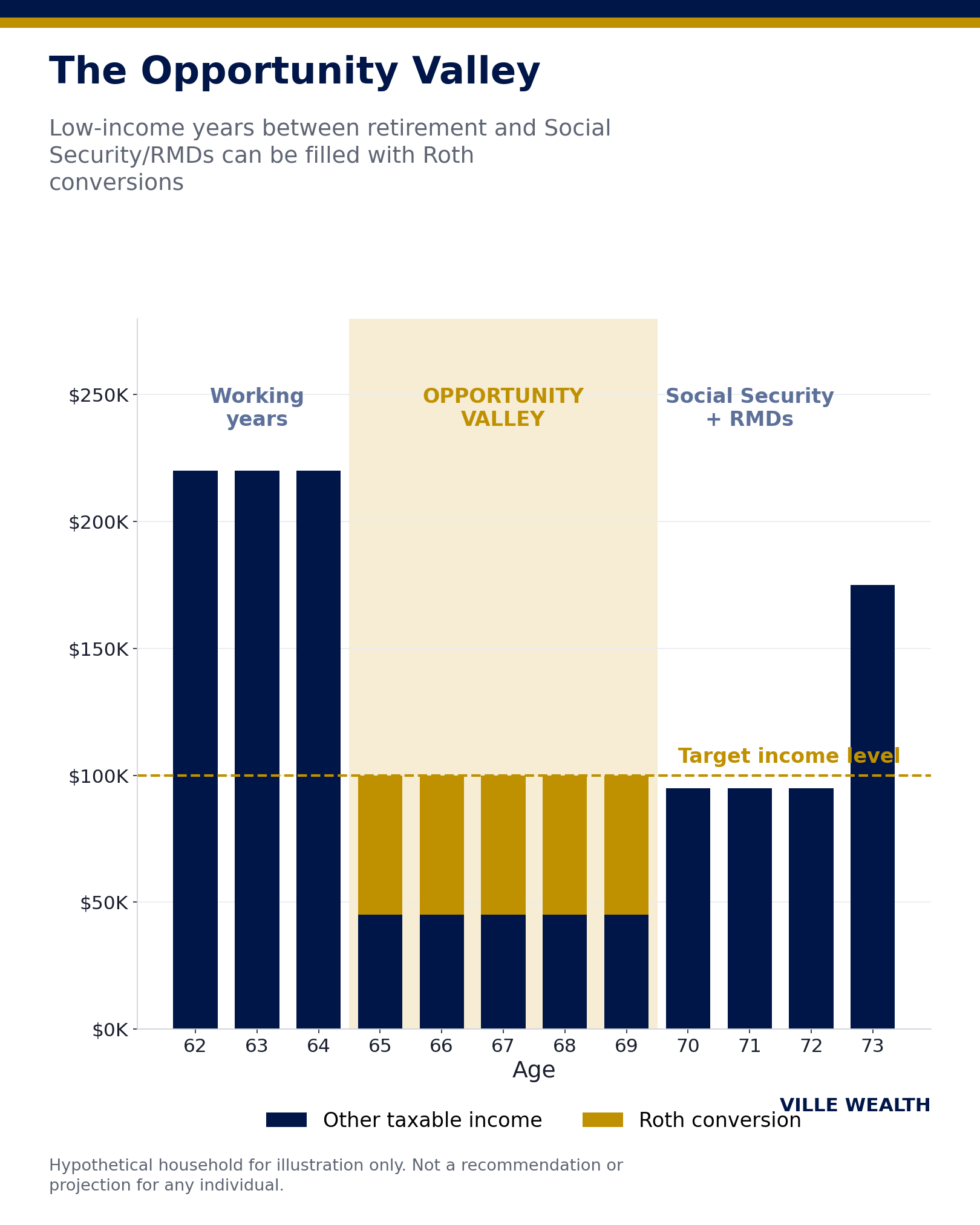
For many people, the best time to convert is a stretch of unusually low-income years. This often happens after work ends but before Social Security and required minimum distributions (RMDs) begin. We call this the opportunity valley. With no paycheck coming in, you may be able to fill the lower tax brackets on purpose with conversions. That locks in a lower tax rate on money that might otherwise be taxed at a higher rate later.
2. You Want to Shrink Future RMDs and Avoid the "Tax Torpedo"
Large tax-deferred balances mean large required distributions later in life. Those forced withdrawals can push you into higher brackets. They can also make more of your Social Security taxable and trigger higher Medicare premiums (IRMAA). Converting part of your balance earlier makes those future RMDs smaller and gives you more control over your taxable income in retirement.
3. You Want to Protect a Surviving Spouse
When one spouse passes away, the survivor usually starts filing as a single taxpayer. Single brackets are much narrower. Often most of the income stays the same, including RMDs, pensions, and part of Social Security, but it gets taxed at higher rates. This is sometimes called the widow(er)'s penalty. Converting while you can still file jointly can mean lower taxes for the spouse who is left.
4. Your Heirs Are (or Will Be) in High Tax Brackets
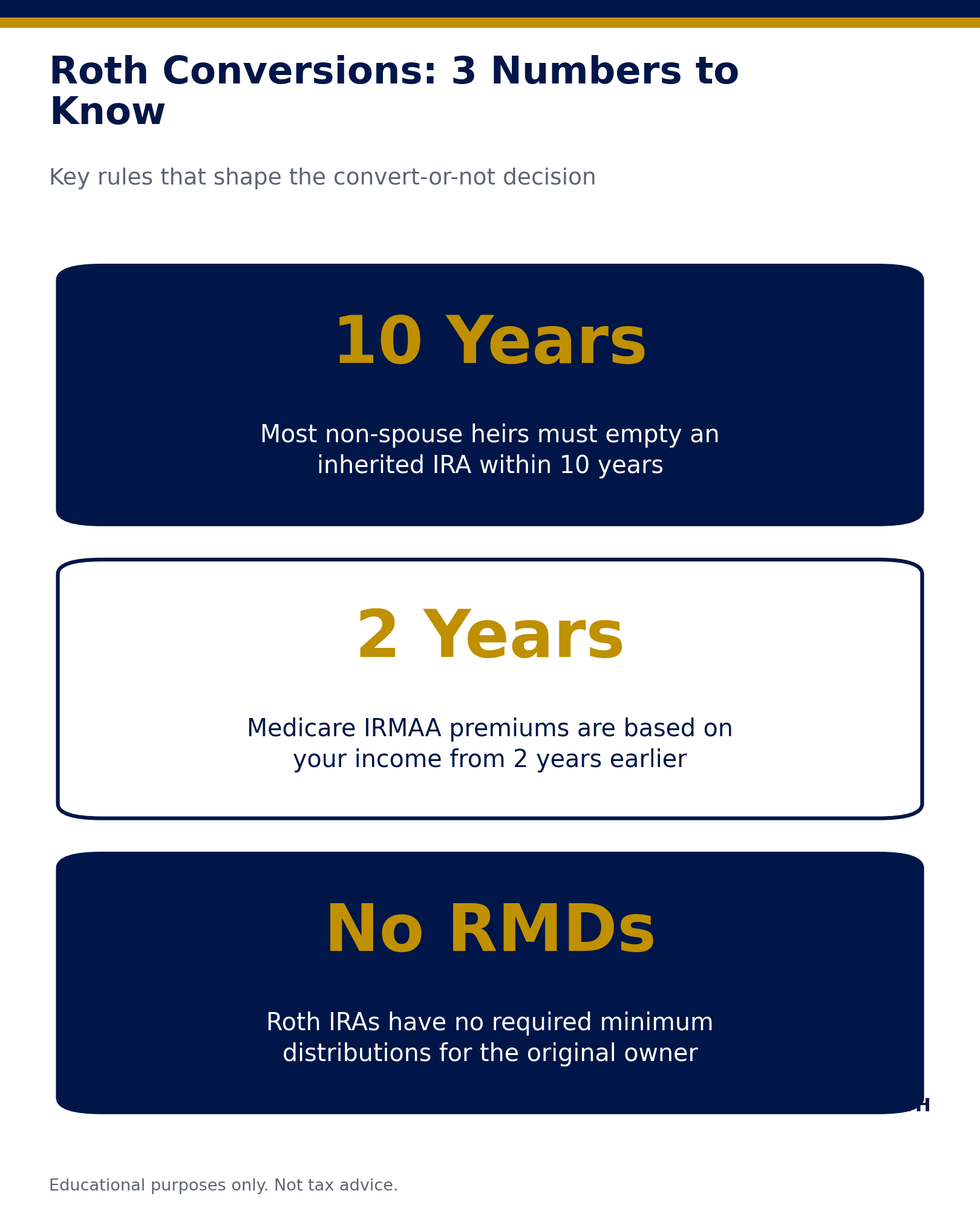
Most non-spouse beneficiaries who inherit a retirement account now have to empty it within 10 years. If your children are in their peak earning years, withdrawals from an inherited traditional IRA get stacked on top of their salaries. That money may be taxed at higher rates than you would pay today. An inherited Roth IRA still has to be emptied, but qualified withdrawals are generally tax-free. In effect, you pay the tax at your lower rate instead of theirs.
5. You Have a Long Time Horizon and Value Flexibility
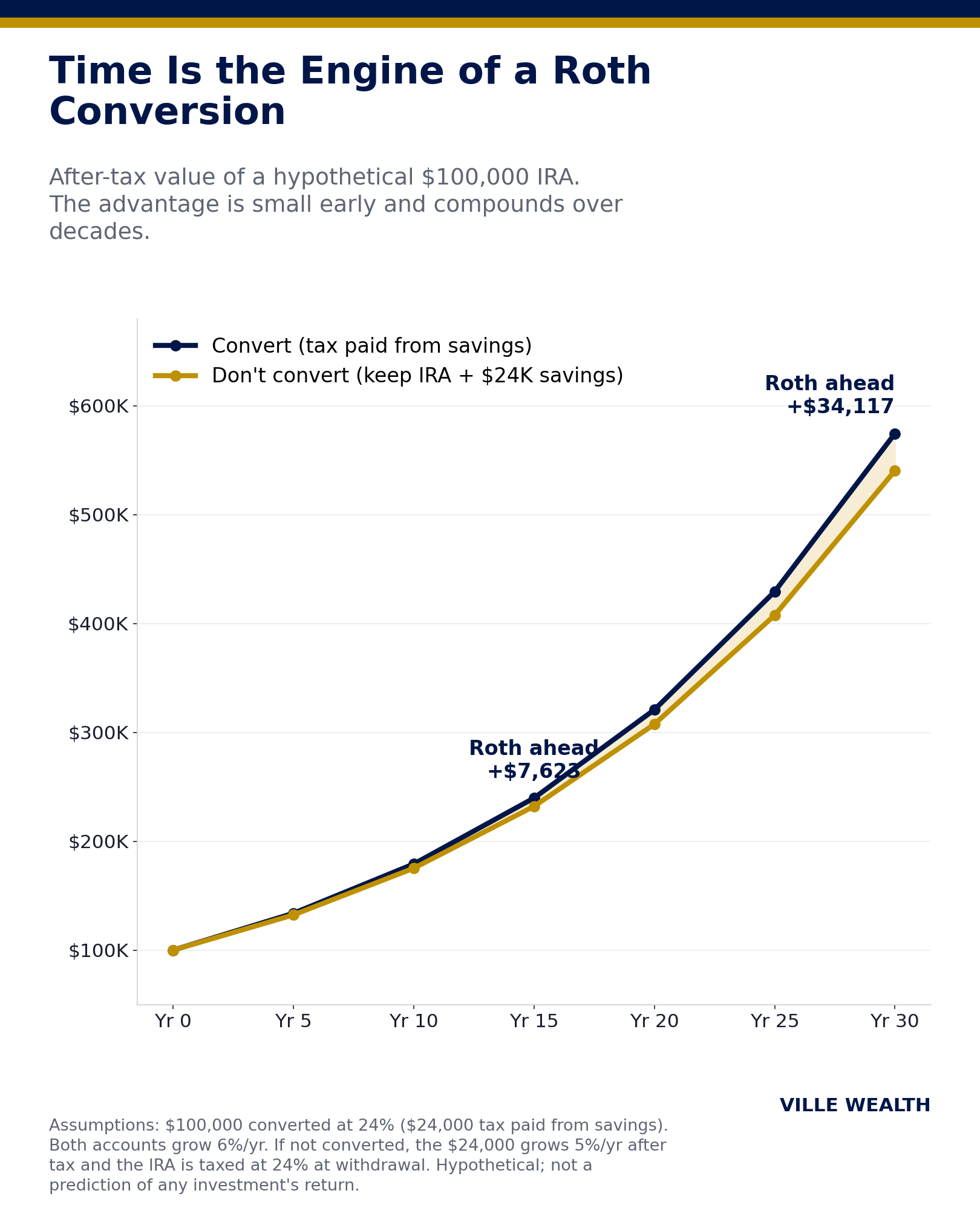
The real power of a Roth is years of tax-free growth. The longer the money stays invested, the bigger the benefit. Roth IRAs also have no RMDs for the original owner. And they give you tax diversification: a pool of money you can draw from in retirement without adding to your taxable income, which helps if tax rates go up in the future.
5 Reasons Not to Convert (or to Convert Less)
1. You Don't Have Enough Assets Outside Tax-Deferred Accounts to Pay the Tax
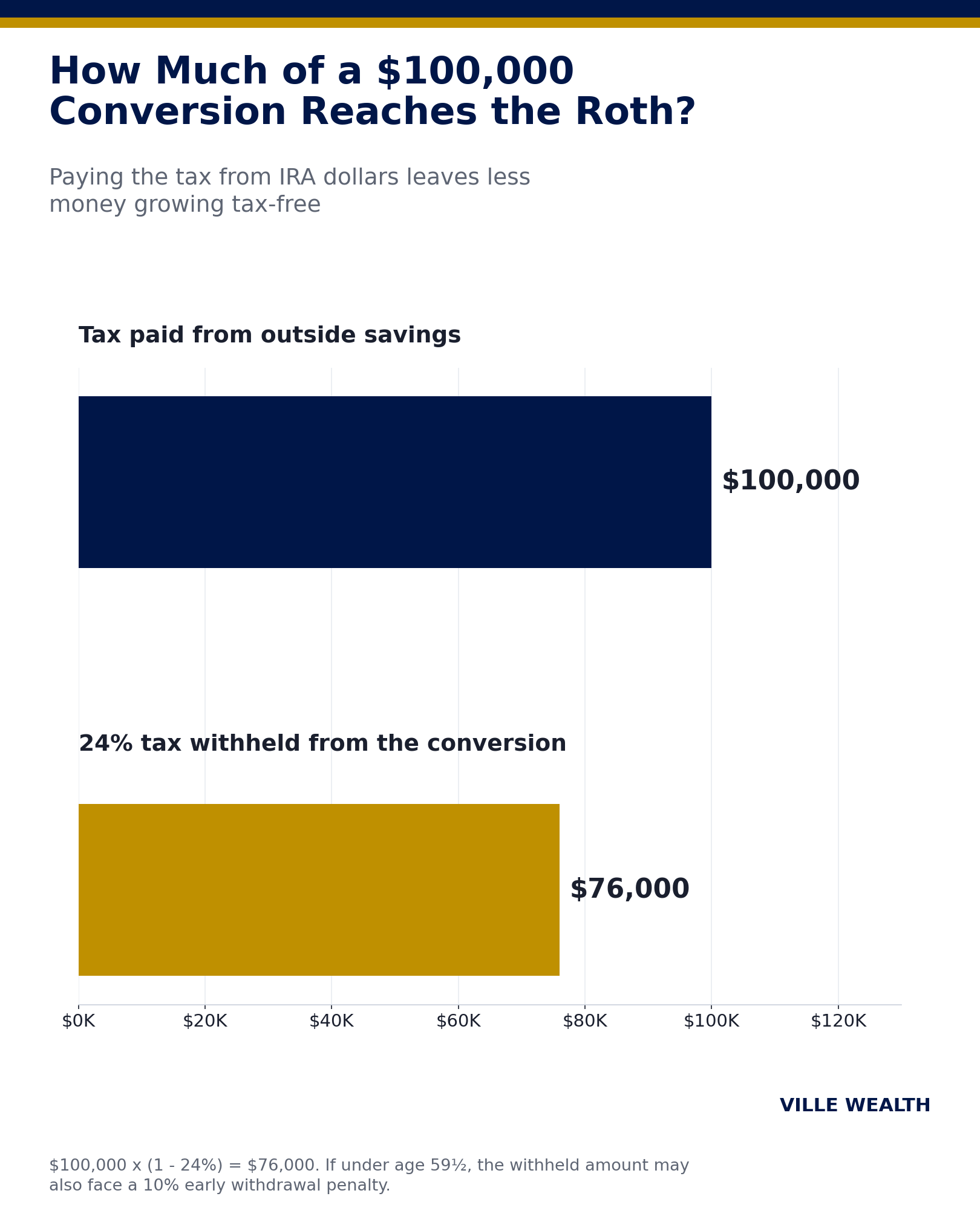
A conversion works best when you pay the tax from outside money, such as cash or a taxable brokerage account. If most of your wealth is in IRAs and 401(k)s, you would have to withhold the tax from the conversion itself. That means less money lands in the Roth to grow tax-free, which cuts into much of the benefit. If you're under age 59½, the amount withheld for taxes may also face a 10% early withdrawal penalty. When outside assets are limited, converting often doesn't add up.
2. Your Children or Beneficiaries Won't Be in a High Tax Bracket
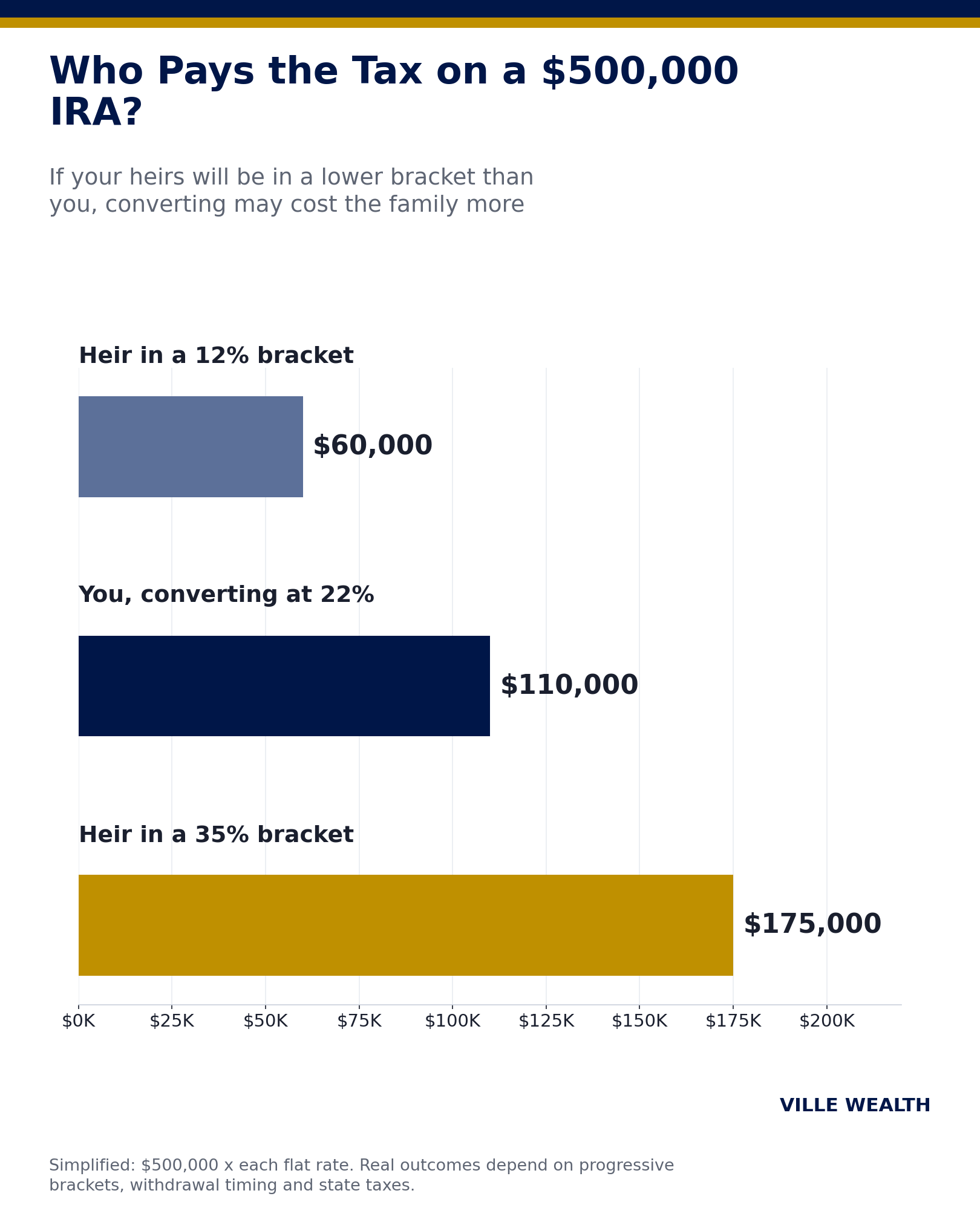
A conversion is partly a bet on who pays the tax and at what rate. If your heirs are likely to be in lower brackets than you are today, it can make more sense to let them pay the tax. They can spread withdrawals from an inherited traditional IRA over the 10-year window. In that case, paying tax at your higher rate today means the family pays more overall, not less.
3. Health Concerns May Shorten Your Time Horizon
Converting means paying a known tax bill today for a benefit that builds over time. The true payoff usually comes from living into your 90s, or from letting the Roth grow for 30 years or more. If health issues make it less likely you'll live past about 85, and you aren't converting mainly for your heirs, you may not live long enough to recover the upfront tax. Paying tax early on money you may never get the full benefit from is a real cost.
4. You Won't Have an Opportunity Valley
Some retirees never get a low-income window. Their taxable income stays high because of:
Pensions starting right at retirement
Deferred compensation payouts spread over several years
Ongoing business income or partnership distributions
Capital gains and dividends from a large taxable portfolio
Rental income from investment real estate
If your income in retirement will be as high as it was while you were working, or higher, a conversion may just move income into a bracket that's just as high or higher. The whole idea behind converting is paying tax at a lower rate now than you would later. Without a valley, that idea may not hold up.
5. The Hidden Costs: Medicare Premiums (IRMAA) and ACA Health Insurance Subsidies
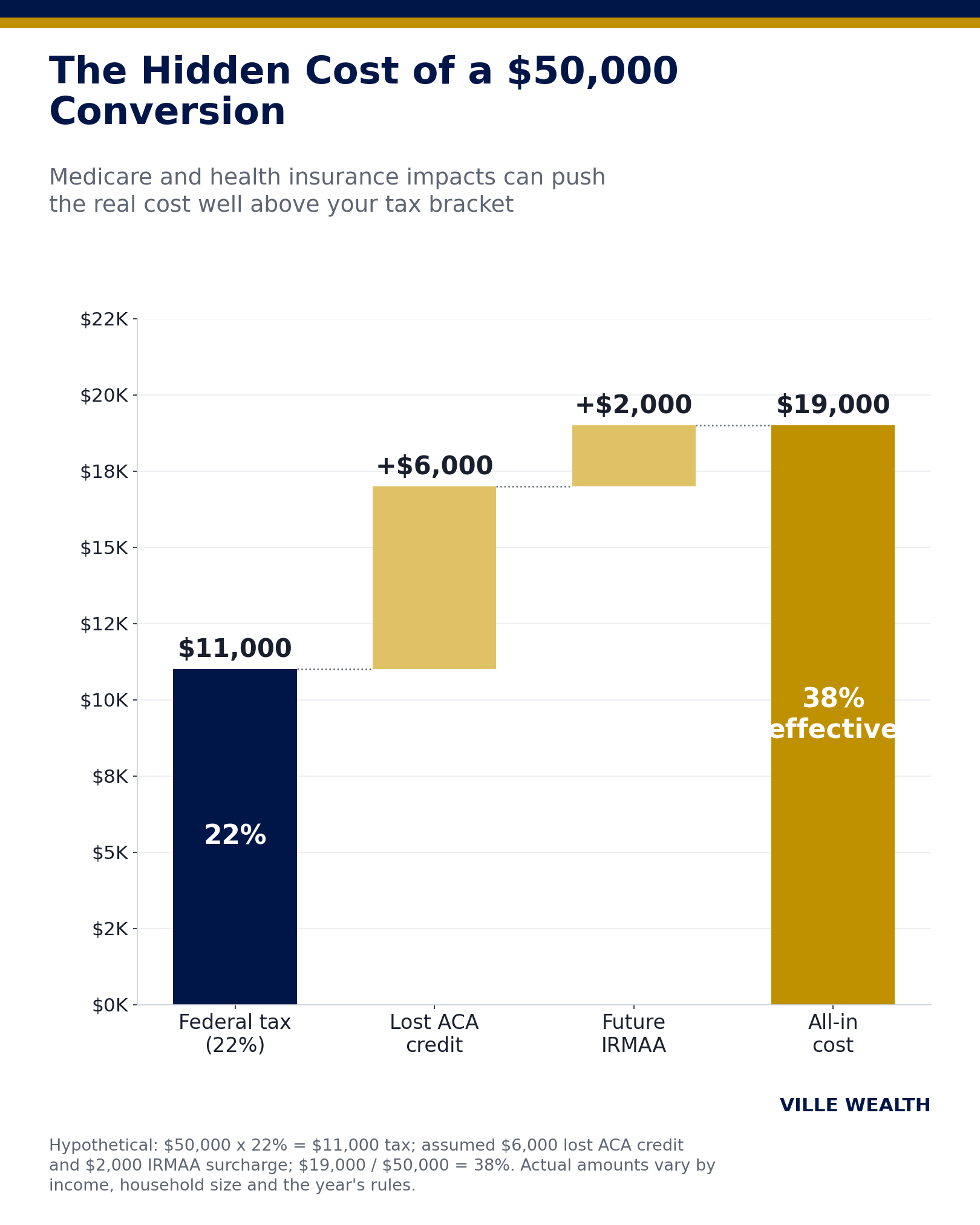
Your tax bracket isn't the only thing a conversion affects. Converted dollars count as income, and that income can raise your costs in other places:
Medicare IRMAA surcharges: Medicare Part B and Part D premiums go up once your income passes certain levels. Those surcharges are based on your income from two years earlier, so a conversion at 63 or later can raise your Medicare premiums down the road. IRMAA works in tiers. Going even one dollar over a threshold can bring the full surcharge for that tier, for both spouses.
ACA premium tax credits: If you retire before 65 and buy health insurance through the ACA marketplace, your subsidy depends on your income. A conversion can shrink your premium tax credit or wipe it out, which can add thousands of dollars to what you pay for coverage that year.
The senior deduction (through 2028): A temporary federal deduction gives taxpayers 65 and older up to $6,000 each ($12,000 for a married couple who both qualify) for tax years 2025 through 2028. It shrinks as income rises above certain levels, so a conversion can reduce or eliminate it. On the other hand, if your income stays below the phase-out range even after converting, the deduction lowers your taxable income and can make a conversion cheaper. Either way, it's worth running the numbers during these four years.
Once you add these costs to the tax on the conversion, the real cost of converting can be much higher than your bracket suggests. That's often a reason to convert smaller amounts, time conversions carefully, or skip converting in certain years.
It's Rarely All or Nothing
The right answer is often somewhere in the middle. Many families do partial conversions, converting only enough each year to fill a target bracket or stay under a key income threshold. They may also spread conversions over several years during an opportunity valley. A good conversion plan also looks at:
Charitable goals: IRA dollars left to charity, or given through Qualified Charitable Distributions (QCDs), may never be taxed, so converting those dollars may not make sense.
The five-year rules that apply to Roth withdrawals.
State income taxes, now and in the state where you may retire.
A Few Things Most People Don't Know
Roth conversions come with rules that aren't obvious. Most of them only come up when someone is already partway through a conversion. Here are the ones we see catch people off guard most often.
1. There's no undo button. Before 2018, you could reverse a Roth conversion if the market dropped or your tax bill turned out higher than expected. That option is gone. Once you convert, the tax is owed, even if the account loses value the next month. That's a big reason to plan conversions carefully instead of doing them on impulse.
2. Anyone can convert, whatever their income. Many people think high earners can't have a Roth IRA. Income limits do apply to contributing directly to a Roth IRA, but not to converting. You also don't need a paycheck to convert. Retirees with no earned income can convert as much as they choose.
3. You can't convert only your after-tax dollars. If you've made non-deductible (after-tax) contributions to an IRA, you might expect to convert just those dollars tax-free. The IRS doesn't allow that. It looks at all of your traditional, SEP and SIMPLE IRAs together, and each conversion is treated as a proportional mix of taxed and untaxed money. This is called the "pro-rata rule," and it surprises a lot of people who try a "backdoor" Roth.
4. Your required minimum distribution comes out first. Once RMDs begin, the first dollars you take out of your IRA each year count toward that year's RMD, and an RMD can't be converted. If you plan to convert in an RMD year, you have to take the RMD first and then convert on top of it.
5. The deadline is December 31, not April 15. You can make an IRA contribution for last year up until the tax filing deadline. A conversion counts in the calendar year it happens. If it isn't done by December 31, it goes toward next year's taxes.
6. You don't have to sell anything to convert. You can usually move investments into the Roth "in kind," meaning the same shares, without selling them first. That makes a market drop a possible opportunity. When prices are down, you can move the same number of shares for a smaller tax bill, and any recovery happens inside the Roth, tax-free.
7. A conversion can raise taxes on other income. Conversion income is added to the rest of your income, and that can have side effects. More of your Social Security benefits can become taxable. Your long-term capital gains and dividends can move into a higher tax rate. It can also trigger the extra Medicare tax on investment income. These ripple effects often cost more than the added bracket rate on the conversion itself.
8. Paying the tax from your IRA can cost you twice. If you're under 59½ and have taxes withheld from the conversion, the withheld amount counts as a regular distribution. That means income tax plus a 10% early withdrawal penalty. Paying the tax from outside savings avoids this and puts more money into the Roth.
9. You may need to pay some tax before April. A large conversion can mean you owe more than your usual withholding covers. If you don't make an estimated payment or increase your withholding during the year, you could owe an underpayment penalty on top of the tax.
10. What your heirs get depends on who they are. A surviving spouse can generally treat an inherited Roth IRA as their own, keep it growing tax-free, and skip required withdrawals for life. Most other heirs have to empty the account within 10 years, but those withdrawals are generally tax-free. That's a big improvement over inheriting a traditional IRA during peak earning years.
The Bottom Line
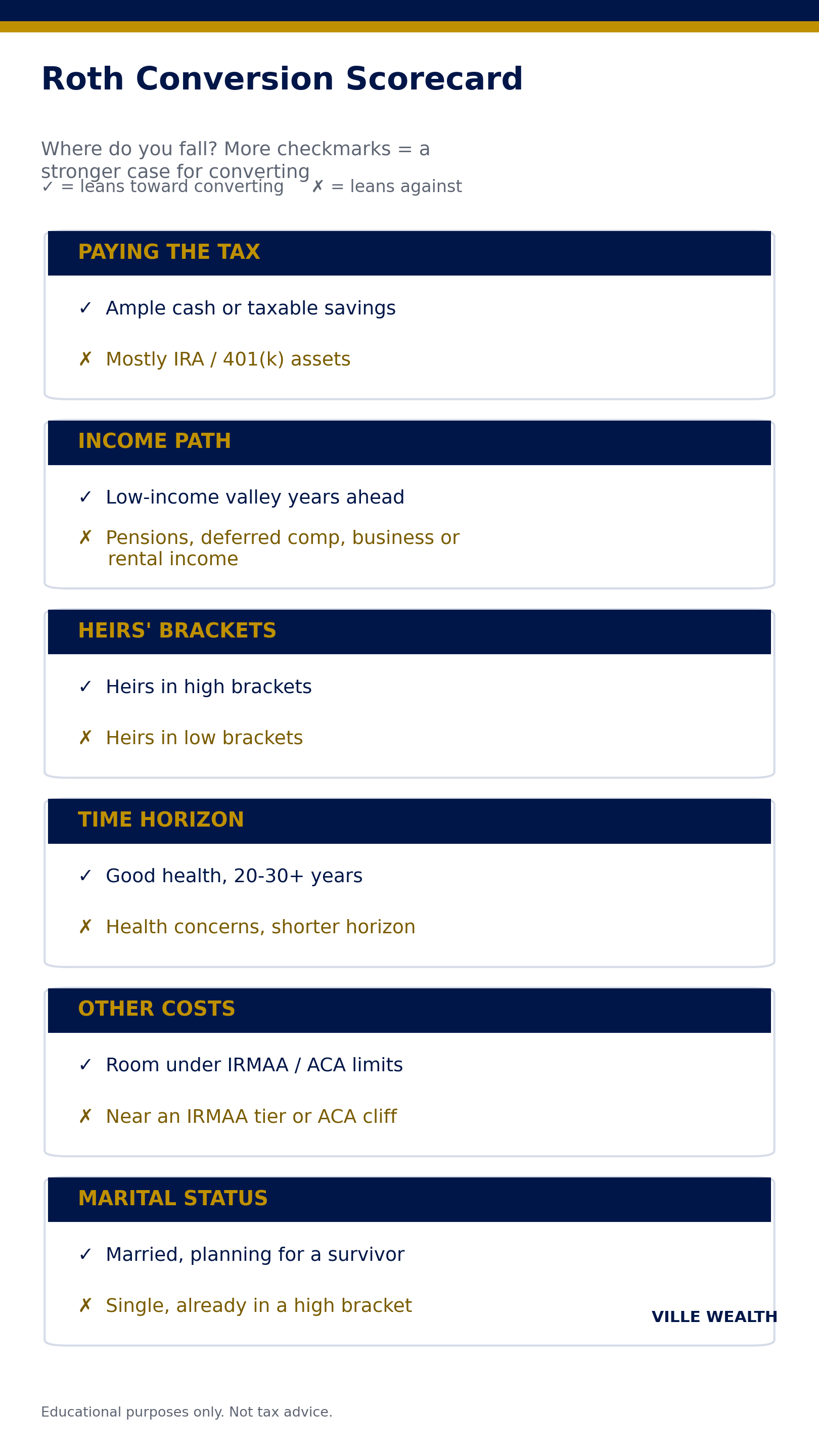
A Roth conversion is a tax decision, a cash-flow decision, a healthcare-cost decision, and an estate decision all at once. The best candidates usually have money outside their IRAs to pay the tax, a low-income window to convert in, a long time horizon, and heirs in higher brackets. If those pieces aren't in place, holding off may be the better choice.
At Ville Wealth, we model conversions year by year alongside your full financial picture, including Medicare and health insurance costs. That way, the decision is based on your numbers, not rules of thumb. Contact us to find out whether a Roth conversion fits your plan.
This material is for informational and educational purposes only and does not constitute tax, legal, or investment advice. Tax laws are subject to change, and individual circumstances vary. Please consult a qualified tax professional regarding your specific situation before taking action.
Ville Wealth Management is a Registered Investment Adviser in the state of Ohio. Advisory services are only offered to clients or prospective clients where Ville Wealth Management and its representatives are properly registered or exempt from registration. “Likes” should not be considered a positive reflection of the investment advisory services offered by Ville Wealth Management. Brian Jaros is an investment adviser representative of Ville Wealth Management. The firm is a registered investment adviser and only conducts business in jurisdictions where it is properly registered, or is excluded or exempted from registration requirements. Registration as an investment adviser is not an endorsement of the firm by securities regulators and does not mean the adviser has achieved a specific level of skill or ability. The information presented on this post is believed to be factual and up-to-date, but we do not guarantee its accuracy and it should not be regarded as a complete analysis of the subjects discussed. Comments should not be construed as an offer to buy or sell, or a solicitation of an offer to buy or sell the investments mentioned. A professional adviser should be consulted before implementing any of the strategies discussed. Investments involve varying degrees of risk, and there can be no assurance that any specific investment or strategy will be suitable or profitable for a client's portfolio. All investment strategies can result in profit or loss.
