
Retiring at 55 is not a fantasy. For the right person with the right plan, it is entirely achievable. But it requires a level of financial preparation that goes well beyond what most pre-retirees have done -- and several decisions that cannot be undone once made.
If you are in your early to mid-50s and retirement at 55 is on your radar, this guide walks through the real financial picture. Not the optimistic version. The honest one.
The First Question -- Can You Actually Afford It?
Before anything else, you need to know your number. How much does your retirement actually cost per year -- and how much do you have to fund it?
A common starting point is the 4% rule: multiply your annual spending by 25 to get the portfolio size needed to sustain a 30-year retirement. But retiring at 55 means your portfolio may need to last 40 years or more -- which changes the math significantly.
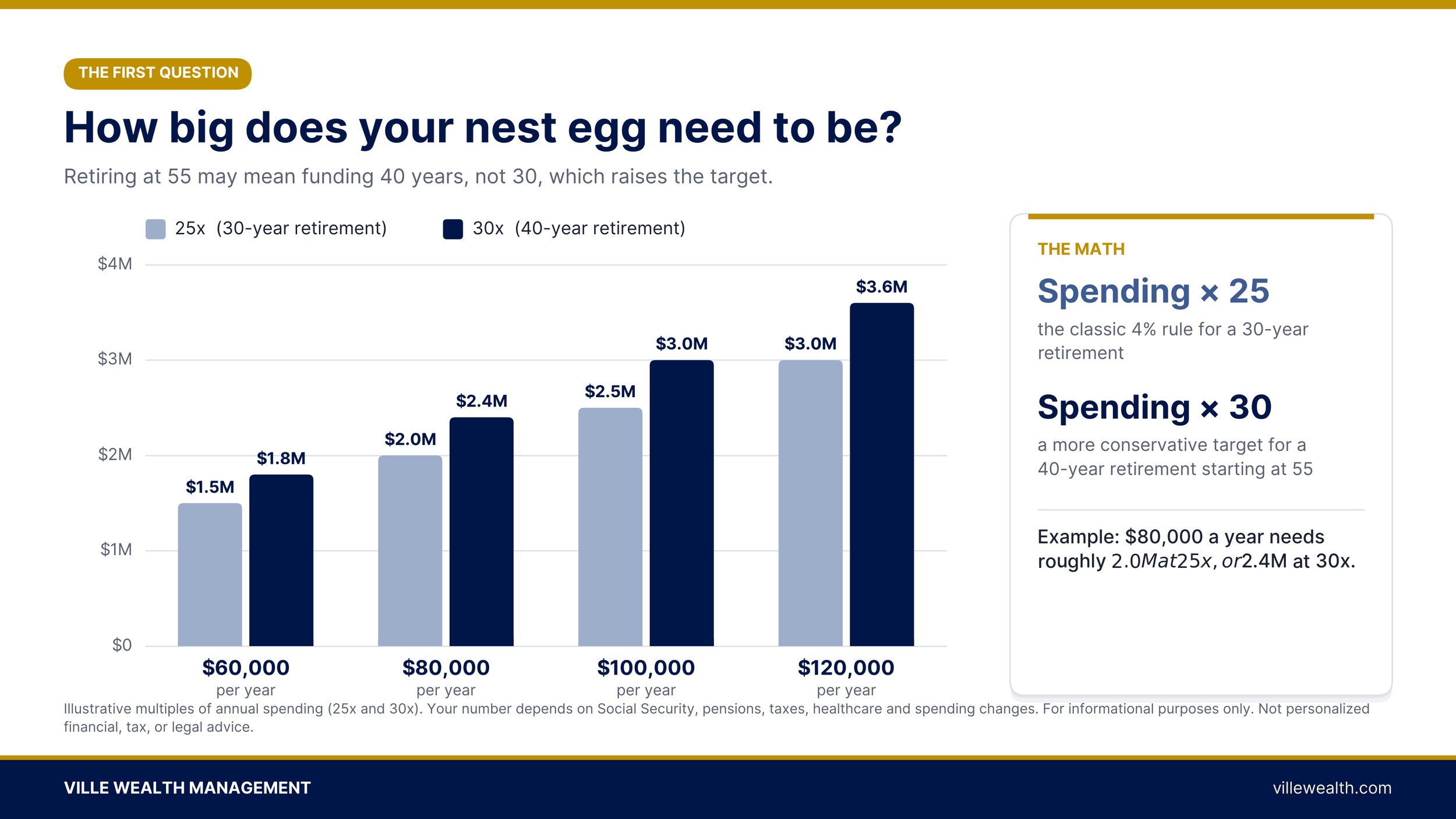
This is a starting point -- not a final answer. Your actual number depends on Social Security income, any pension, your Ohio tax situation, healthcare costs, and how your spending changes over a 40-year retirement. We build this model in full detail for every client.
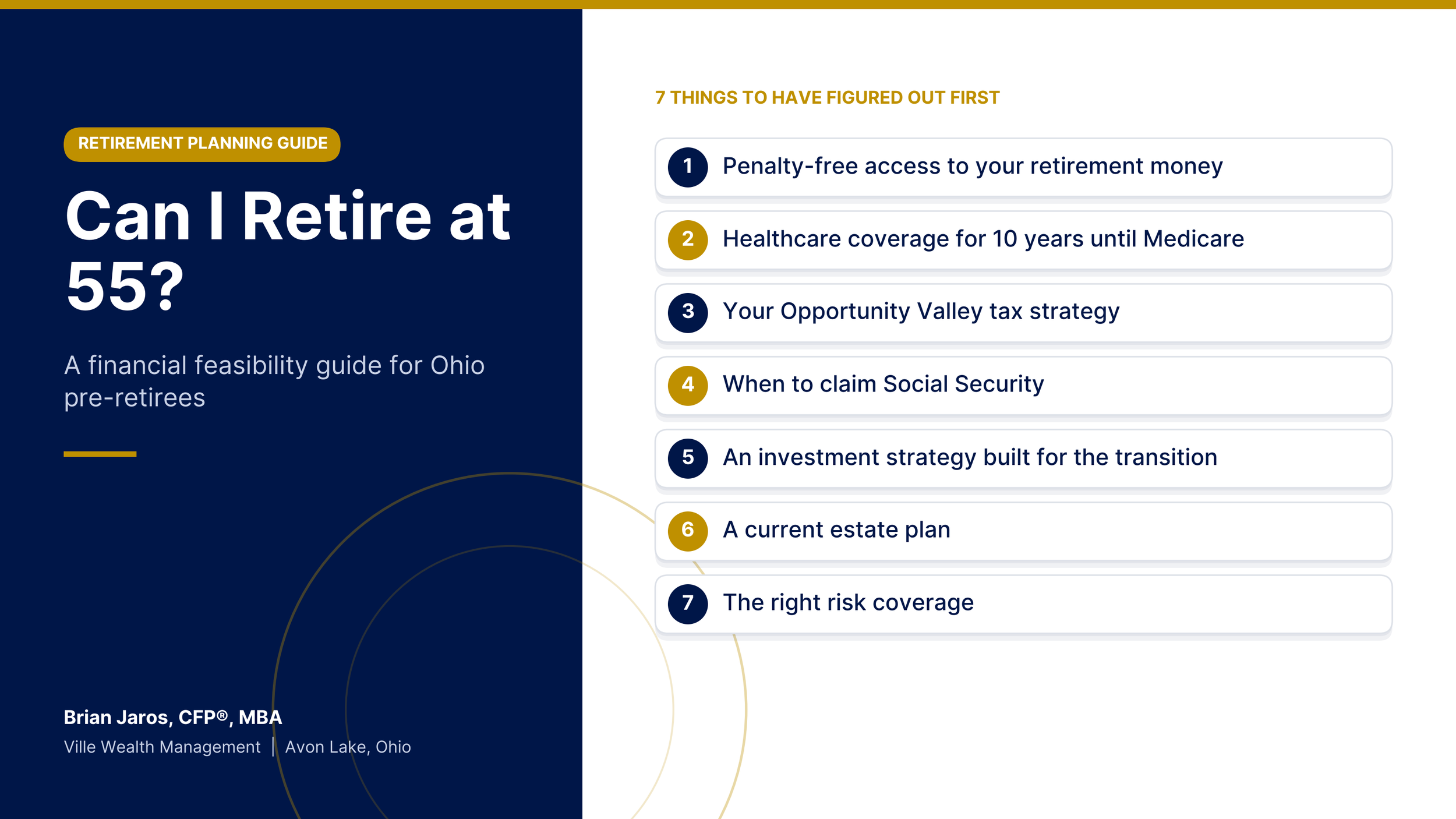
The Seven Things You Need to Have Figured Out Before You Retire at 55
1. How Will You Access Your Retirement Money Without a Penalty?
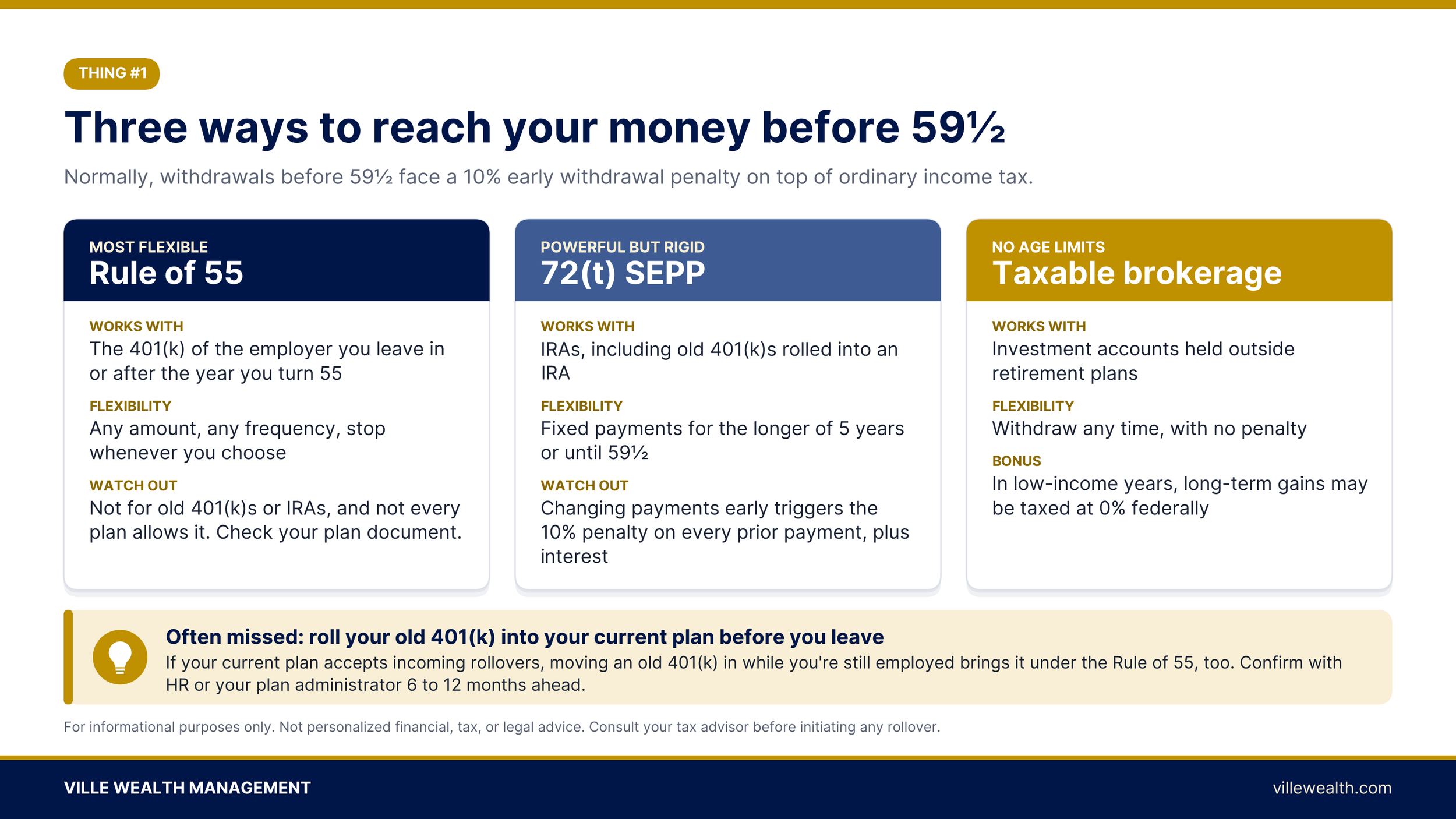
This is the question most people forget to ask until it is too late. The standard rule is that you cannot withdraw from an IRA or 401(k) before age 59 and a half without paying a 10% early withdrawal penalty -- on top of ordinary income tax.
Retiring at 55 means you face a 4.5-year gap before penalty-free access. Here are your three main options:
The Rule of 55
If you leave your employer in or after the year you turn 55, you can take penalty-free withdrawals directly from that employer's 401(k) -- in any amount, at any frequency, stopping whenever you choose. No penalty. No commitment required.
This only applies to the 401(k) of the employer you are leaving -- not old 401(k)s from prior employers, and not IRAs. And not all plan providers allow it even though the IRS permits it. Before counting on the Rule of 55, review your plan document to confirm it is permitted.
If your plan document restricts Rule of 55 withdrawals, there is a workaround. In a single transaction, you can roll a portion of your 401(k) to an IRA and take the remaining balance as a direct distribution. Because you separated from service in or after the year you turned 55, the distribution qualifies for penalty-free treatment. Your 401(k) provider should code the distribution as a code 2 on Form 1099-R -- if they mistakenly use code 1 you can file Form 5329 Part I and claim a code 01 exception.
Read the full Rule of 55 guide here: [villewealth.com/blog/rule-of-55]
The Often-Missed Strategy -- Roll Your Old 401(k) Into Your Current Employer Plan Before You Leave
Here is a strategy most people never consider. If you have an old 401(k) sitting at a former employer, you may be able to roll it into your current employer's 401(k) plan before you retire. Once those funds are inside your current employer's plan, they fall under the same Rule of 55 umbrella -- giving you penalty-free access to that money the moment you leave at 55, alongside your existing current employer balance.
Not all employer plans accept incoming rollovers from other plans -- check with your HR department or plan administrator well before your retirement date to confirm whether your current plan allows it. If it does, initiating the rollover while you are still employed gives you significantly more flexibility and a larger pool of penalty-free accessible funds at retirement.
This strategy requires advance planning -- ideally 6 to 12 months before your target retirement date -- to allow time for the rollover to process and confirm the Rule of 55 applies to the full combined balance. Consult your tax advisor before initiating any rollover to confirm the tax treatment for your specific situation.
The 72(t) SEPP Plan
For old 401(k)s rolled to an IRA or for IRAs generally, a 72(t) Substantially Equal Periodic Payment plan allows penalty-free withdrawals before 59 and a half. The catch: you must commit to a fixed payment schedule for the longer of five years or until you reach 59 and a half. Modifying or stopping payments before that period ends triggers the 10% penalty retroactively on every prior payment plus interest.
The 72(t) is powerful but rigid. It is not a decision to make casually -- and sizing it correctly requires careful modeling against your income needs, tax bracket, and IRMAA thresholds.
Pro tip: consider splitting your IRA into a separate account sized for the exact 72(t) payment. This keeps your remaining IRA flexible and completely untouched by the fixed schedule.
Read the full 72(t) guide here: [villewealth.com/blog/pre-59-5-ira-withdrawals-72-t-strategy]
Taxable Brokerage Accounts
Taxable brokerage accounts have no age restrictions and no penalty for withdrawal at any time. If you have accumulated significant assets outside of retirement accounts, these are your most flexible early retirement income source -- and during low-income years in the Opportunity Valley, long-term capital gains may be taxed at 0% federal rate.
Learn more: [villewealth.com/retirement-planning]
2. What Will You Do About Healthcare for 10 Years?
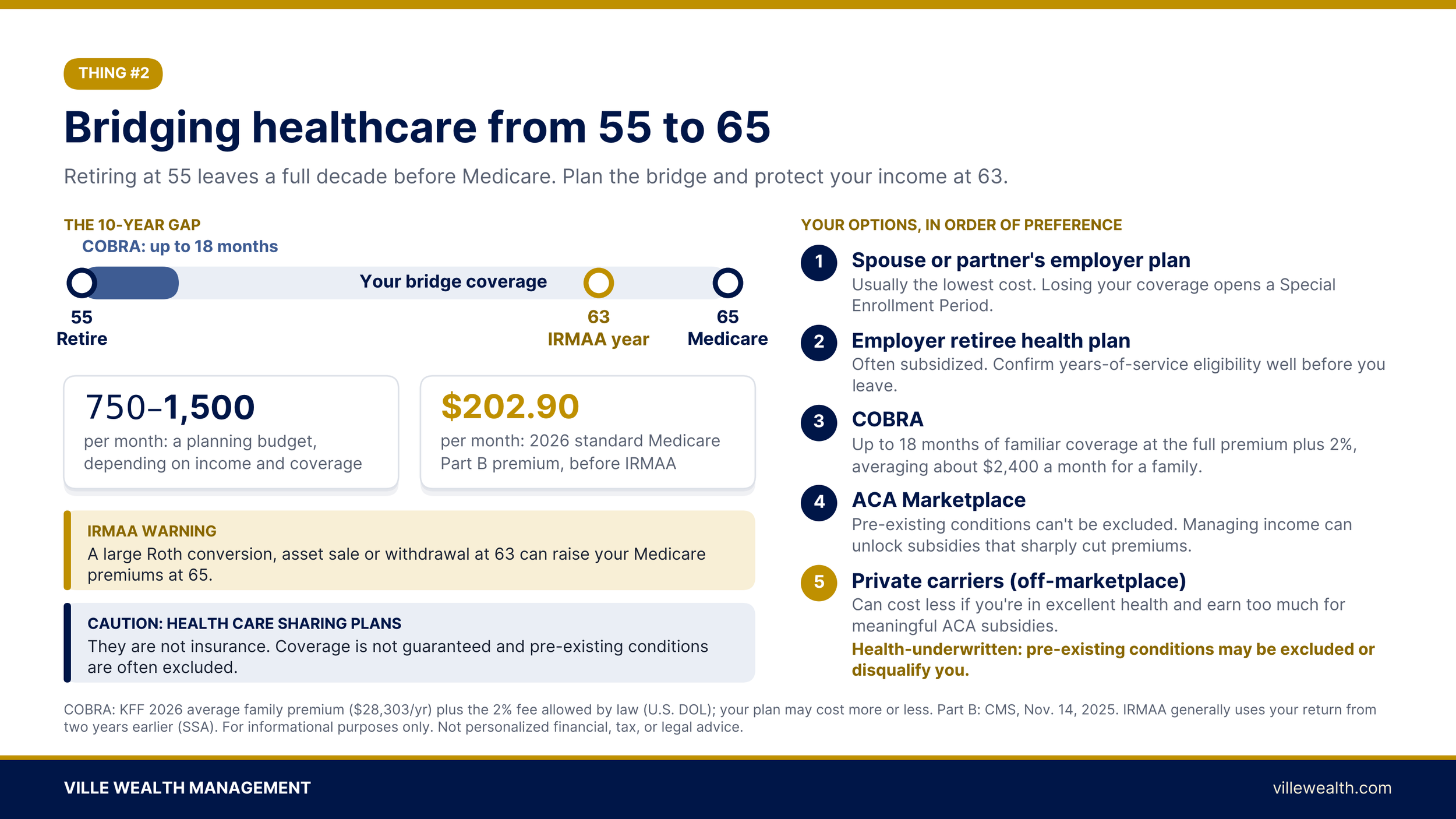
This is the largest financial unknown in most early retirement plans -- and for someone retiring at 55, it spans a full decade before Medicare eligibility at 65.
Your options in order of preference:
Partner or spouse employer plan: If your partner is still working and their employer has 20 or more employees, joining their plan is almost always the lowest-cost option. Losing your own employer coverage qualifies as a Special Enrollment Period -- you can join mid-year without waiting for open enrollment.
Retiree health plan from your employer: Some employers offer retiree health coverage to employees who meet specific years-of-service requirements, often with a meaningful employer subsidy. If you are approaching retirement and your employer offers this, confirm your eligibility well before you leave.
COBRA: Continue your employer's health plan for up to 18 months after leaving. You pay the full premium, both your share and your employer's, plus a 2% administrative fee. Based on 2026 national averages, that's about $2,400 per month for family coverage or about $830 for single coverage, though your plan's cost may be higher or lower. Expensive but familiar coverage with no network disruption.
ACA Marketplace plans: If your retirement income drops below certain thresholds, ACA subsidies can dramatically reduce your premium -- sometimes to near zero. Income management during the Opportunity Valley years can maximize these subsidies significantly.
Private Health Insurance Carriers
Purchasing individual health insurance directly from a private carrier outside the ACA marketplace can offer lower premiums than marketplace plans -- particularly for healthy individuals. Because private carriers underwrite based on health status, they draw from a healthier pool which can reduce costs significantly.
The tradeoff is real. Pre-existing conditions are frequently excluded -- serious conditions such as a prior stroke, heart attack, or certain cancers may be excluded entirely or disqualify you from coverage. What looks like a bargain premium can become a catastrophic gap when you need it most.
Worth investigating if you are in excellent health with no significant pre-existing conditions and your income is too high for meaningful ACA subsidies. If you have any history of serious illness, the marketplace -- where pre-existing conditions cannot be excluded -- is almost certainly the safer choice.
Health Care Sharing Plans: These are frequently marketed to early retirees as a low-cost alternative to insurance. They are not insurance. Pre-existing conditions are typically excluded, coverage is not legally guaranteed, and there is no regulatory protection if a claim is denied. Understand the limitations carefully before relying on one as your primary coverage.
For planning purposes, budget $750 to $1,500 per month for healthcare depending on your income and coverage choice -- and plan for IRMAA at age 63.
The IRMAA Warning
Your income at age 63 sets your Medicare Part B and Part D premiums at age 65. The standard 2026 Part B premium is $202.90 per month. A large Roth conversion, asset sale, or significant withdrawal at 63 can push you into IRMAA surcharges that cost hundreds more per month for the rest of your Medicare years. We build IRMAA planning into every client's income strategy starting well before age 63.
Learn more: [villewealth.com/healthcare-planning]
3. What Does the Opportunity Valley Look Like for You?
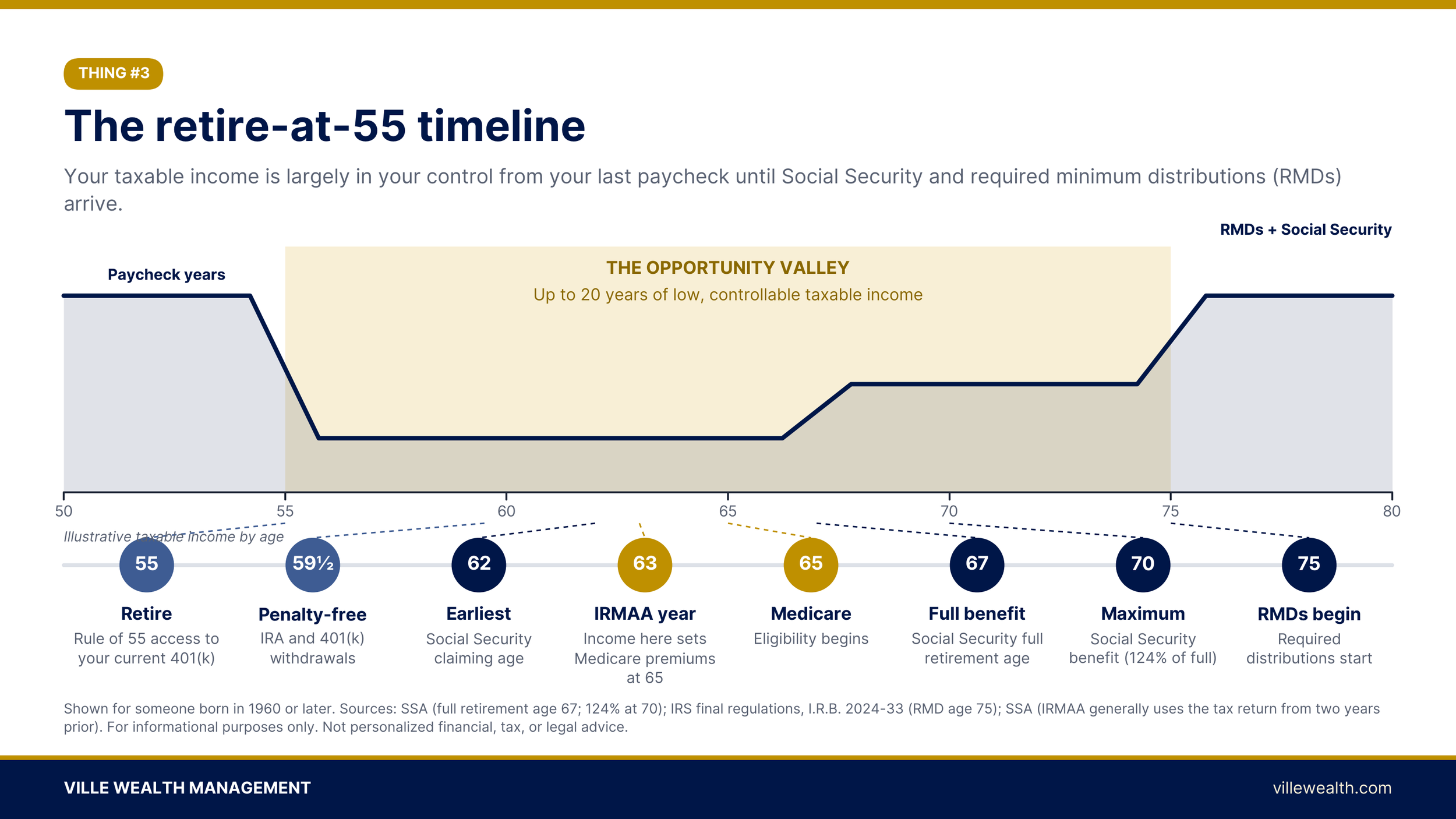
The Opportunity Valley is the low-income window that opens when your last paycheck stops and closes when Social Security and Required Minimum Distributions push your income back up. For someone retiring at 55 and born in 1960 or later, this window can span 20 years -- from age 55 to RMDs at 75.
This is the most powerful tax planning period of your entire financial life.
During this window your taxable income is almost entirely within your control. The strategies available to you include:
Strategic IRA and 401(k) withdrawals: Drawing from your large tax-deferred balance at 12% or 22% now -- rather than being forced out at 24% or higher when RMDs arrive -- permanently reduces future RMD pressure and can save tens of thousands in lifetime taxes.
Roth conversions where appropriate: Converting pre-tax dollars to Roth during low-income years locks in today's lower tax rate and creates future tax-free income that does not trigger IRMAA surcharges or Social Security taxation.
Capital gains harvesting at 0%: In 2026, married filers with taxable income below $98,900 pay zero federal tax on long-term capital gains. Low-income retirement years are ideal for resetting your taxable account cost basis at zero federal tax.
The right combination of these strategies depends entirely on your account mix, projected RMDs, Social Security claiming age, Medicare timeline, and estate goals. We model it annually and recalibrate as your situation evolves.
Learn more: [villewealth.com/tax-planning]
4. When Will You Take Social Security -- and What Does the Gap Cost?
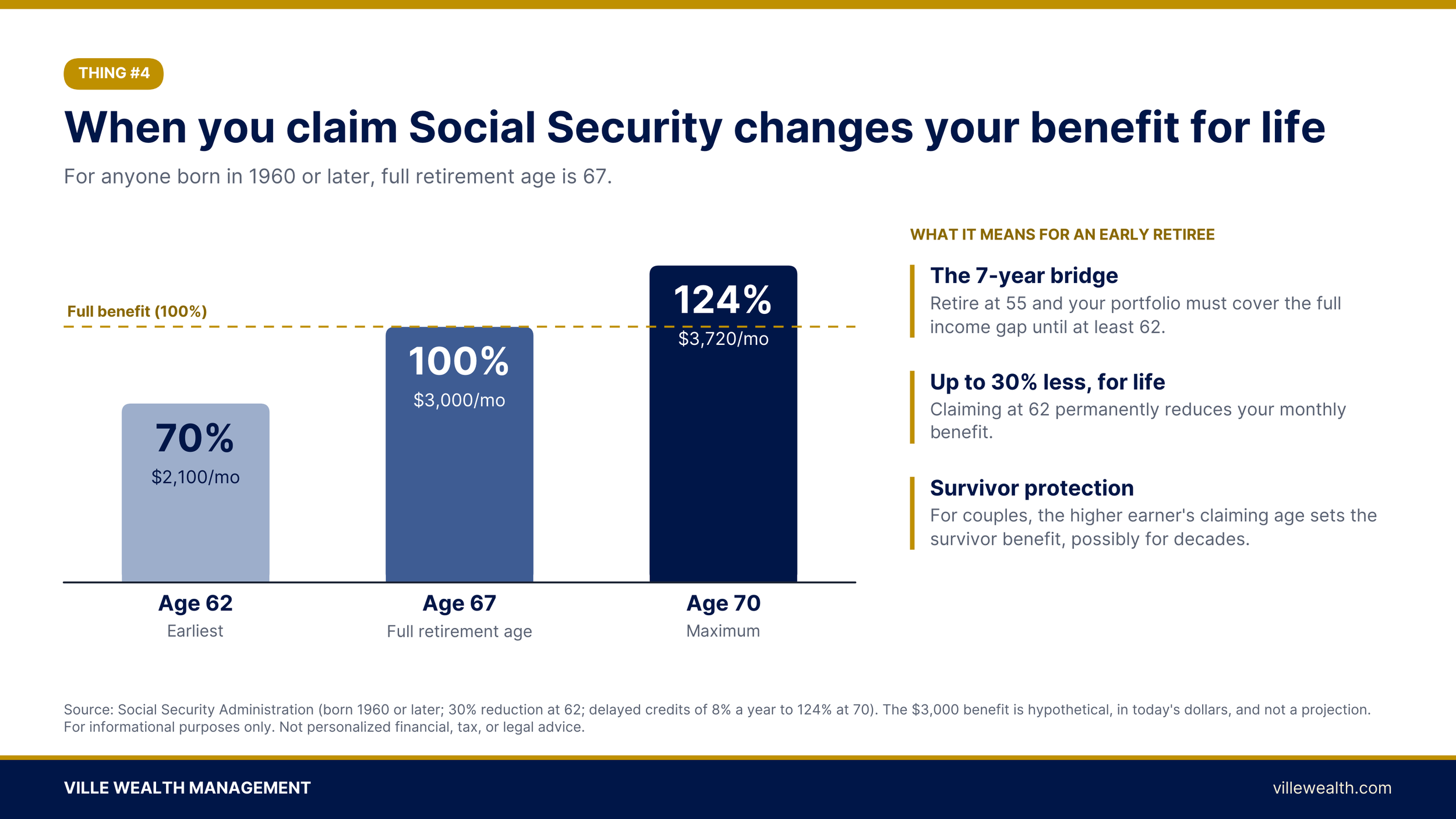
Retiring at 55 means you cannot claim Social Security for at least 7 years -- and the question of when to claim between 62 and 70 is one of the most consequential decisions of your retirement.
Claiming at 62 permanently reduces your benefit by up to 30%. Waiting until 70 increases it by up to 24% above your Full Retirement Age benefit. For anyone born in 1960 or later, Full Retirement Age is 67.
For the 7 years between retirement at 55 and earliest Social Security at 62, your portfolio must bridge the full income gap. This is a critical cash flow planning consideration and one of the reasons the Opportunity Valley years require careful management.
For married couples the analysis is even more important. The higher earner's claiming decision sets the survivor benefit for the surviving spouse -- potentially for decades after one spouse passes. Getting this wrong can cost a surviving spouse tens of thousands per year.
Learn more: [villewealth.com/social-security-planning]
5. What Is Your Investment Strategy for the Retirement Transition?
The investment strategy that built your wealth over 30 years is not the same one that will protect and distribute it over the next 40.
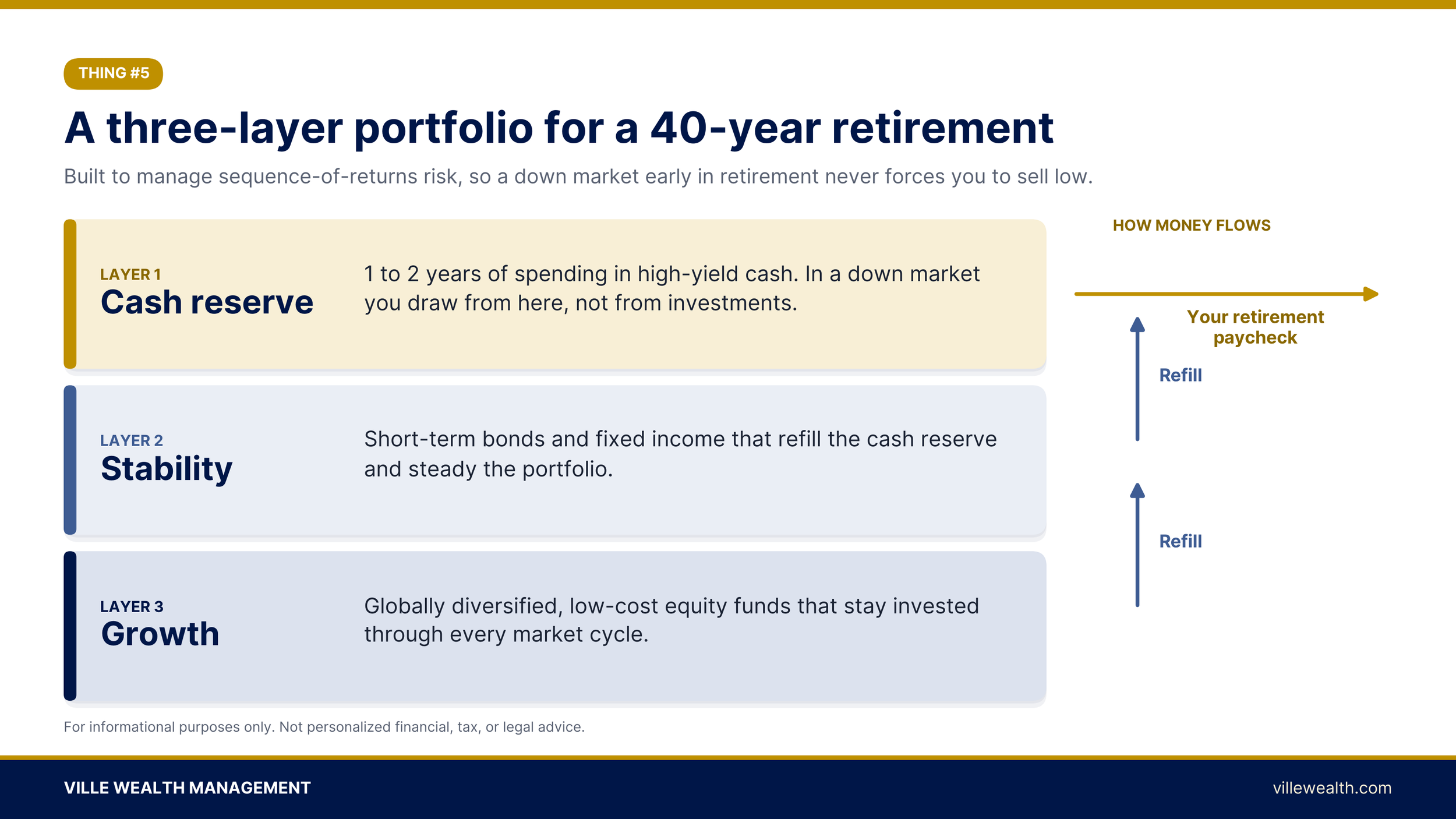
Sequence of returns risk is the primary investment concern for anyone retiring at 55. A significant market decline in the first years of retirement -- combined with ongoing withdrawals -- can permanently impair a portfolio that might otherwise have recovered fully given time.
The structure we build for every retirement portfolio addresses this directly:
Layer 1 -- Cash Reserve: 1 to 2 years of spending in your High-Yield Cash account at Altruist, earning 3.75% APY for 90-day promotional rate (3.45% standard) as of November 16, 2026. This reserve may reduce the need to sell investments during market volatility. No advisory fee applies to High-Yield Cash. APYs are variable, may change at any time and are not guaranteed.
Layer 2 -- Stability: Short-term bonds and fixed income ETFs that refill the cash reserve after drawdown and steady the portfolio through volatile markets.
Layer 3 -- Growth: Globally diversified, low-cost equity ETFs from Vanguard, iShares, and SPDR averaging approximately 4 basis points in annual expense. Stays invested through every market cycle.
For taxable accounts, we may use direct indexing for the U.S. large-cap core portion of the portfolio, owning the individual stocks instead of a single fund. This allows tax-loss harvesting at the individual stock level throughout the year, and harvested losses can offset capital gains and, within IRS limits, a portion of ordinary income. The rest of the portfolio stays in low-cost ETFs. Included for all taxable account clients at no extra charge.
Learn more: [villewealth.com/investment-management]
6. Is Your Estate Plan Current?
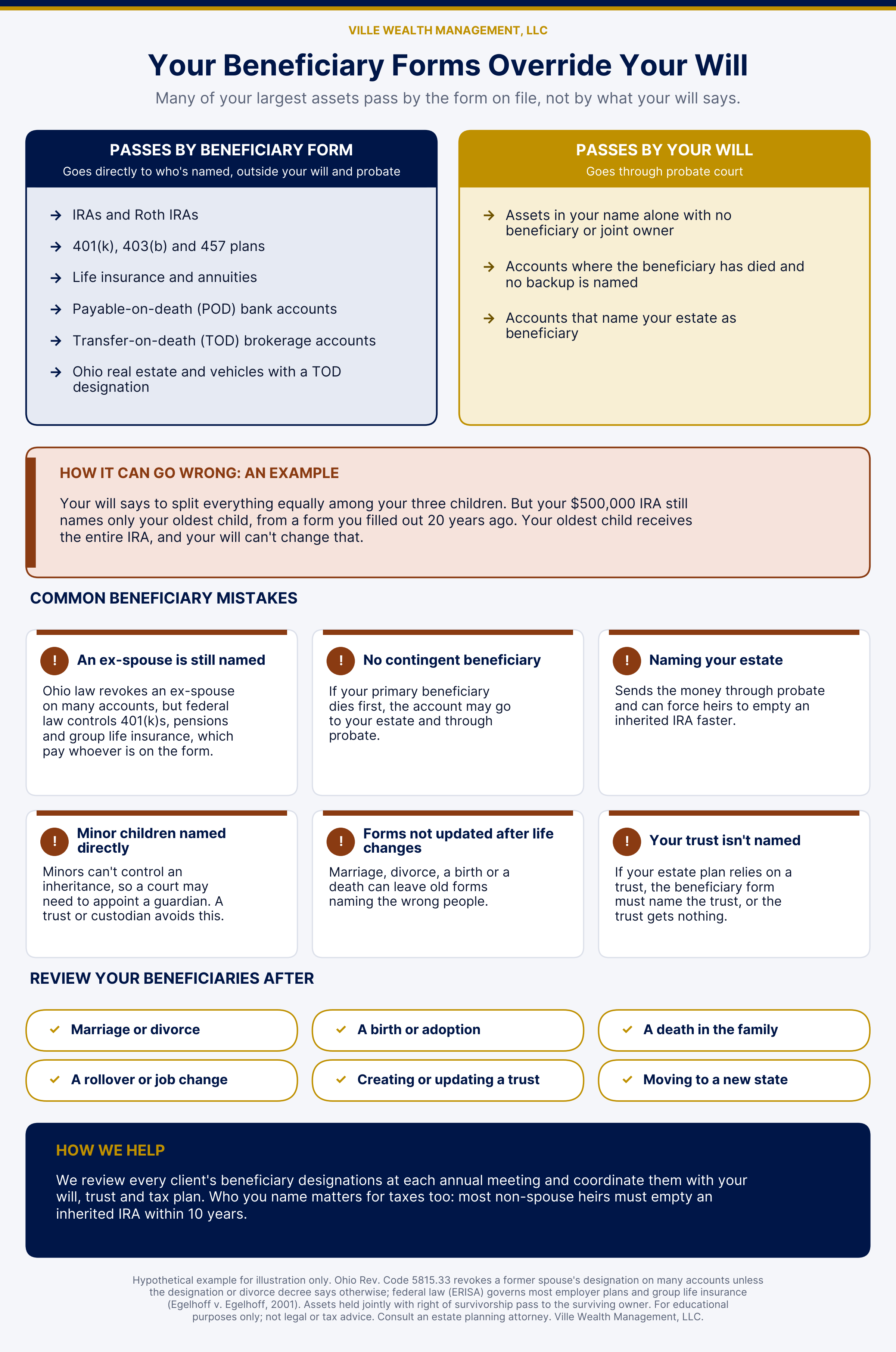
Retiring at 55 means your estate plan needs to reflect your life as it is today -- not as it was when you first created it years ago. Beneficiary designations on IRAs, 401(k)s, and life insurance override your will entirely. A designation that has not been reviewed in years may already be directing your assets to the wrong person.
Before you retire, confirm:
Every beneficiary designation is current across every account
Your account titling is correct and coordinates with your estate documents
You have a durable power of attorney and healthcare directive in place
Your trust is funded if you have one
Learn more: [villewealth.com/estate-planning]
7. Do You Have the Right Risk Coverage in Place?
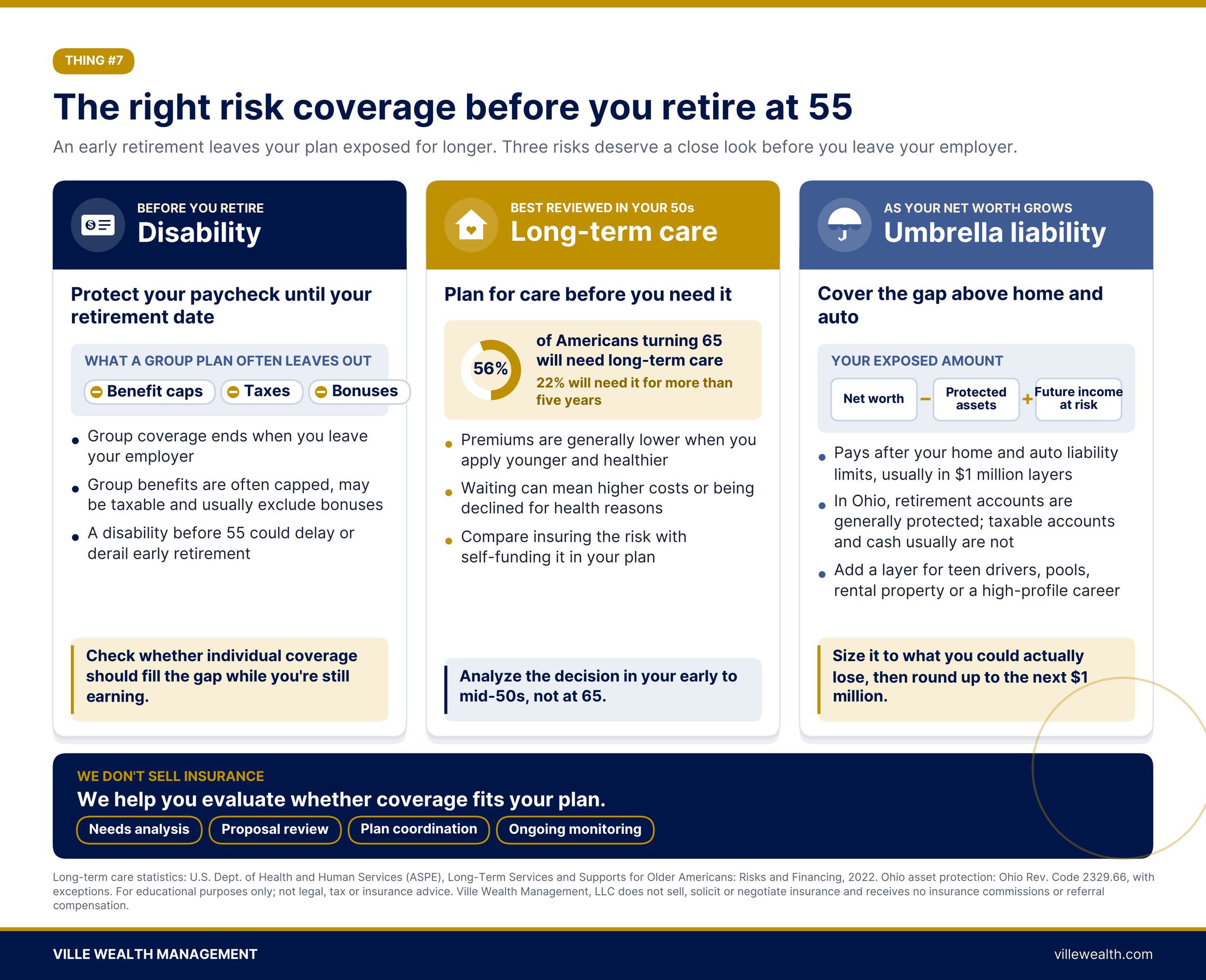
Retiring at 55 means your financial plan is exposed to risks for a longer period than most retirees face. Three risk areas deserve specific attention before you leave your employer:
Disability insurance: Once you retire, employer disability coverage ends. If you become unable to work before 59 and a half and have not yet reached financial independence, the absence of disability coverage creates real exposure. Confirm whether you need individual coverage to bridge the gap.
Long-term care: The U.S. Department of Health and Human Services estimates that 56% of Americans turning 65 will develop a disability serious enough to need long-term care. Analyzing coverage in your early to mid-50s, when premiums are generally lower and you're more likely to qualify medically, is worth the conversation.
Umbrella liability: As your net worth grows, the gap between your standard liability coverage and your actual exposure widens. An umbrella policy adds liability coverage on top of your home and auto policies, typically in $1 million increments, and is often one of the more cost-effective ways to protect the assets you've built.
Learn more: [villewealth.com/risk-management]
The Ohio-Specific Advantages Worth Knowing
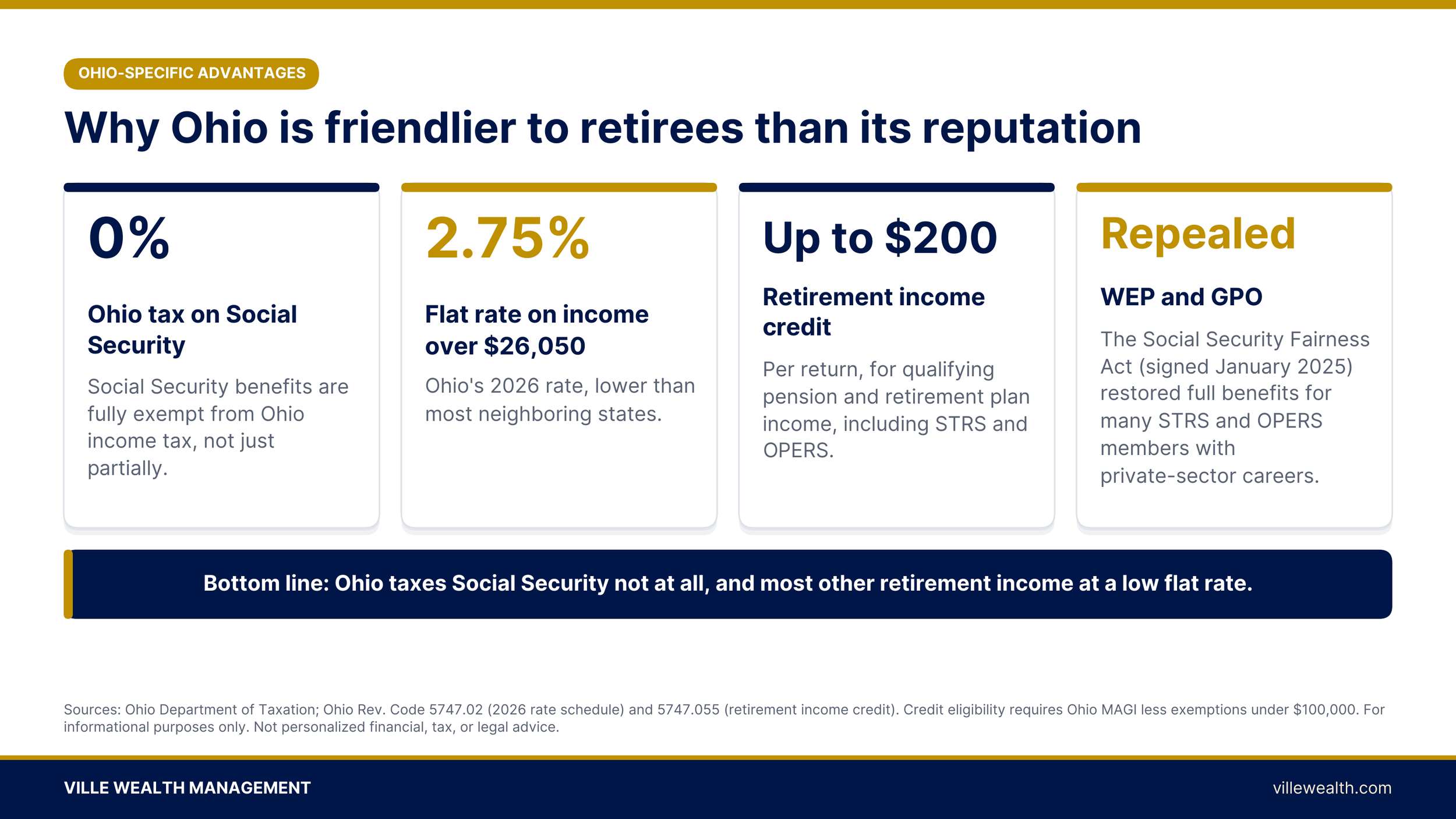
Retiring in Ohio has several genuine financial advantages that do not get enough attention:
Social Security is fully exempt from Ohio income tax. Not partially exempt -- fully exempt. For retirees with significant Social Security income, this is a meaningful advantage over many other states.
Ohio's flat rate is 2.75% in 2026 on income above $26,050. This is lower than most neighboring states and makes Ohio more retirement-friendly than its reputation suggests.
STRS and OPERS retirement income is taxed in Ohio -- but the Ohio retirement income credit of up to $200 per return partially offsets the impact for qualifying taxpayers.
The Social Security Fairness Act, signed January 5, 2025, permanently repealed the Windfall Elimination Provision (WEP) and Government Pension Offset (GPO). This is a significant change for Ohio teachers and public employees covered by STRS or OPERS, and it updates any analysis done before 2025:
If you had a prior private-sector career, your STRS or OPERS pension no longer reduces the Social Security benefit you earned from those years.
If you spent your whole career as a teacher or public employee and never paid into Social Security, you may now qualify for a spousal benefit on your spouse's work record. That benefit can be up to 50% of your spouse's full retirement age benefit. Before the repeal, your government pension could reduce or wipe out that benefit. If your spouse dies, the survivor benefit can be up to 100% of what your spouse received.
Timing matters. Your spouse must already be receiving Social Security for you to claim a spousal benefit. The full 50% is available only if you wait until your own full retirement age. Claiming as early as 62 reduces it to as little as 32.5%. And if you have never applied, you may need to file an application.
What the First 90 Days of Retirement Should Look Like
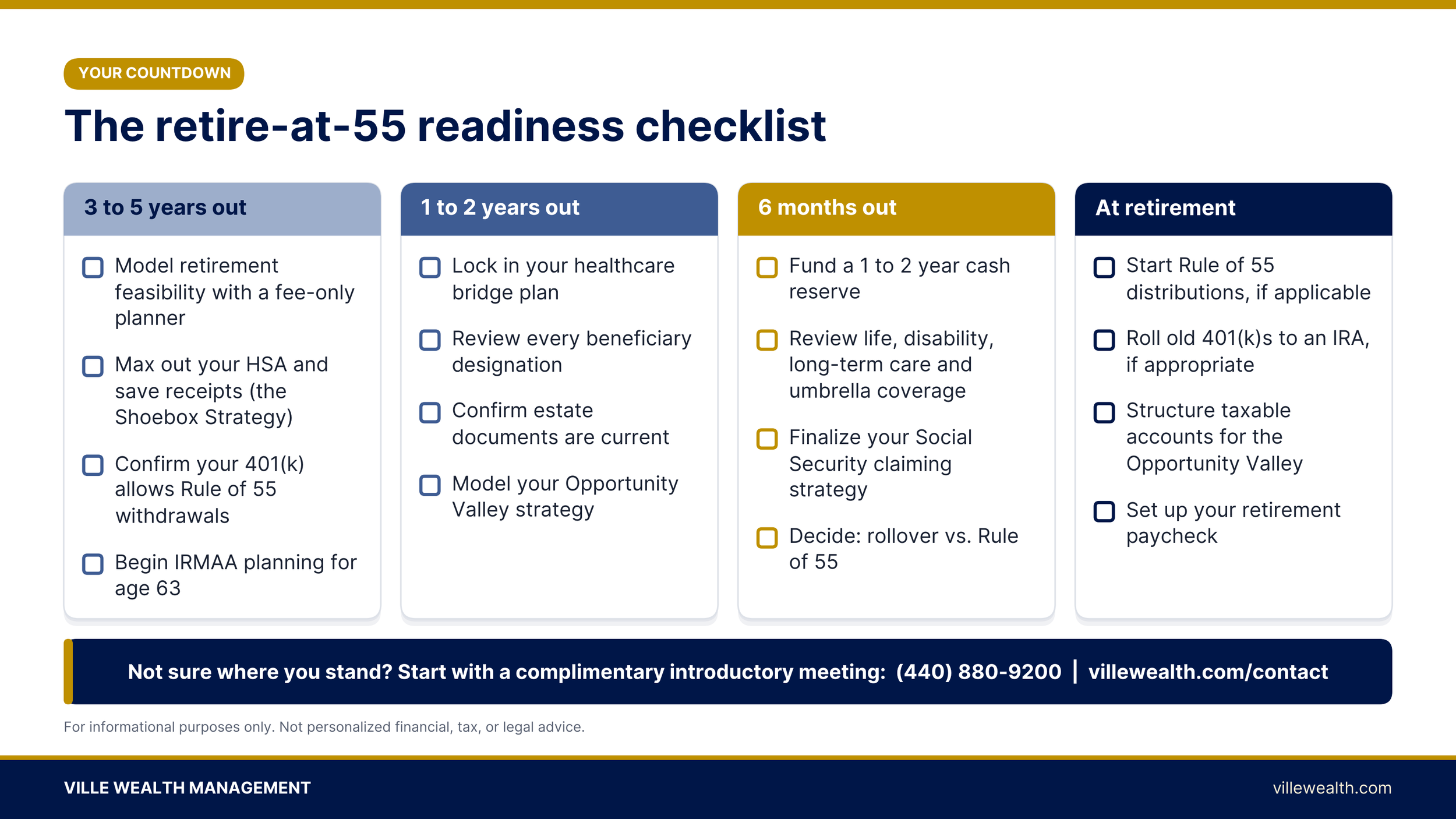
If 55 is your target, here is a checklist of what should be in place before you hand in your notice:
Three to five years out:
Begin modeling retirement feasibility with a fee-only financial planner
Maximize HSA contributions and start the Shoebox Strategy -- saving receipts for future tax-free reimbursement
Confirm whether your employer's 401(k) plan allows Rule of 55 withdrawals
Begin IRMAA planning -- income management at 63 sets Medicare premiums at 65
One to two years out:
Confirm your healthcare bridge plan -- partner plan, retiree coverage, COBRA, or ACA
Review all beneficiary designations across every account
Confirm your estate documents are current
Model your Opportunity Valley strategy -- IRA withdrawal sequencing, Roth conversion sizing, capital gains harvesting plan
Six months out:
Confirm cash reserve is funded -- 1 to 2 years of spending in High-Yield Cash
Review life insurance, disability, LTC, and umbrella coverage
Finalize Social Security claiming strategy -- even if you will not file for 7 years, the analysis affects everything else
Confirm your 401(k) plan rollover vs. Rule of 55 strategy
At retirement:
Initiate Rule of 55 distributions from current 401(k) if applicable
Roll old 401(k) to IRA at Altruist if appropriate
Structure taxable accounts and begin Opportunity Valley planning
Set up the paycheck approach -- cash reserve distributions timed to arrive with other income sources
Is Retiring at 55 Right for You?
Retiring at 55 is achievable -- but it demands more preparation, more planning, and more coordination across more financial variables than retiring at 65. Healthcare, early account access, Opportunity Valley tax planning, and a 40-year investment horizon all require specific strategies that a standard retirement plan does not address.
The best way to find out whether 55 is feasible for your specific situation is to run the numbers -- not with a calculator, but with a comprehensive financial plan that models every scenario across your complete financial picture.
The first step is a complimentary introductory meeting. We will get to know each other, take an honest look at where your retirement plan stands, walk through what Ville Wealth Management does and what it costs, and together determine whether moving forward makes sense for both of us.
Ready to Find Out If Your Retirement Plan Is on Track?
The first step is a complimentary introductory meeting -- no cost, no obligation, and no sales pitch. We will get to know each other, take an honest look at where your retirement plan stands, walk through what Ville Wealth Management does and what it costs, and together determine whether moving forward makes sense for both of us.

Ville Wealth Management is a Registered Investment Adviser in the state of Ohio. Advisory services are only offered to clients or prospective clients where Ville Wealth Management and its representatives are properly registered or exempt from registration. “Likes” should not be considered a positive reflection of the investment advisory services offered by Ville Wealth Management. Brian Jaros is an investment adviser representative of Ville Wealth Management. The firm is a registered investment adviser and only conducts business in jurisdictions where it is properly registered, or is excluded or exempted from registration requirements. Registration as an investment adviser is not an endorsement of the firm by securities regulators and does not mean the adviser has achieved a specific level of skill or ability. The information presented on this post is believed to be factual and up-to-date, but we do not guarantee its accuracy and it should not be regarded as a complete analysis of the subjects discussed. Comments should not be construed as an offer to buy or sell, or a solicitation of an offer to buy or sell the investments mentioned. A professional adviser should be consulted before implementing any of the strategies discussed. Investments involve varying degrees of risk, and there can be no assurance that any specific investment or strategy will be suitable or profitable for a client's portfolio. All investment strategies can result in profit or loss.
