

If you are between ages 50 and 65, have worked hard for the last three decades, and are starting to wonder whether your retirement plan is truly on track — this guide was written for you.
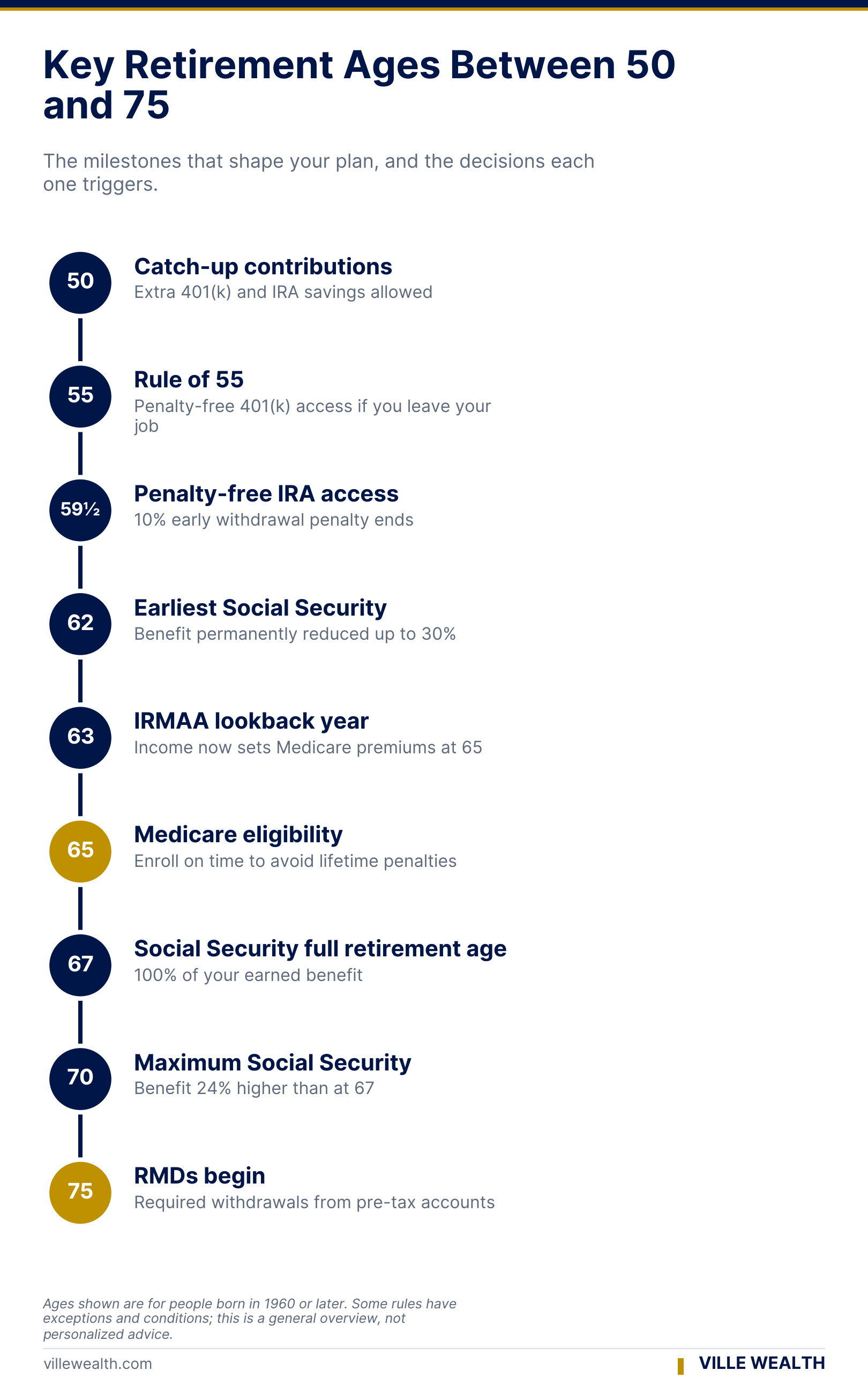
Retirement planning in your 50s and 60s is unlike any financial challenge you have faced before. The decisions you make in this decade are permanent, consequential, and deeply interconnected. When you claim Social Security affects your Medicare premiums. When you take money from your 401(k) affects your tax bracket. How your portfolio is positioned affects whether you can survive a market downturn in the first years of retirement without running out of money.
Most people navigate these decisions alone — or with an advisor who hands them a report and moves on to the next client.
At Ville Wealth Management, we do it differently. We build your plan and we implement it — together. Because a financial plan unimplemented has no value.
Read more: The 10 Retirement Questions Every Pre-Retiree Is Asking — Answered
Retirement Planning for Ages 50-65 in Ohio: The Complete Guide
By Brian Jaros, CFP®
Ville Wealth Management, Avon Lake, Ohio
Who This Guide Is For
This guide is written specifically for pre-retirees who:
Are between ages 50 and 65
Have $250,000 or more in investable assets across all accounts
Are within 5 to 15 years of retirement — or recently retired
Want a comprehensive, fully implemented retirement plan — not a report that sits on a shelf
Are looking for a fee-only, fiduciary advisor with no commissions and no conflicts of interest
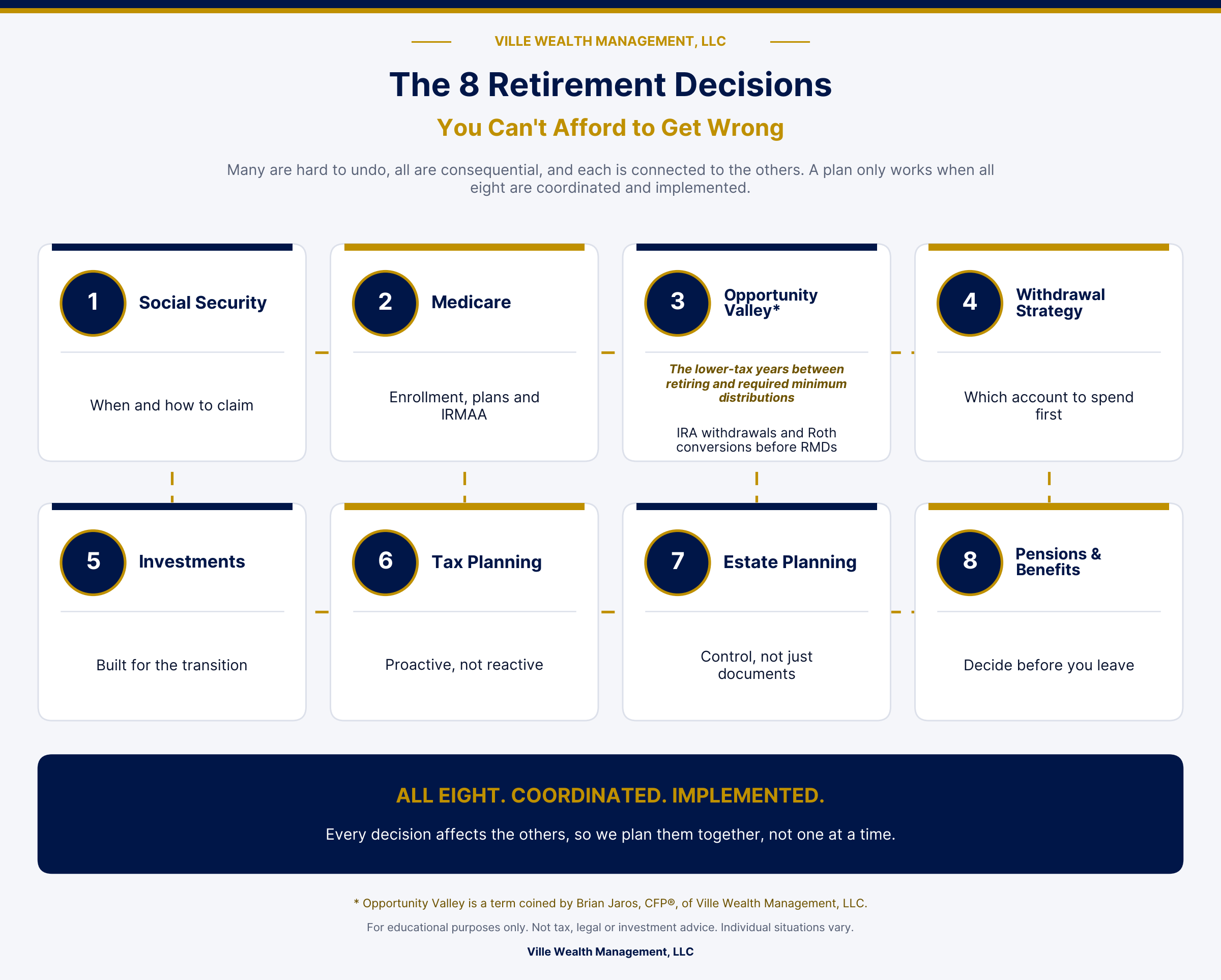
If that describes you, keep reading. Every section below covers one of the eight critical retirement decisions you will face — and links to a deeper resource where you can learn more.
1. Social Security — When and How to Claim
Social Security timing is one of the most consequential financial decisions of your retirement — and most people make it without any analysis whatsoever.
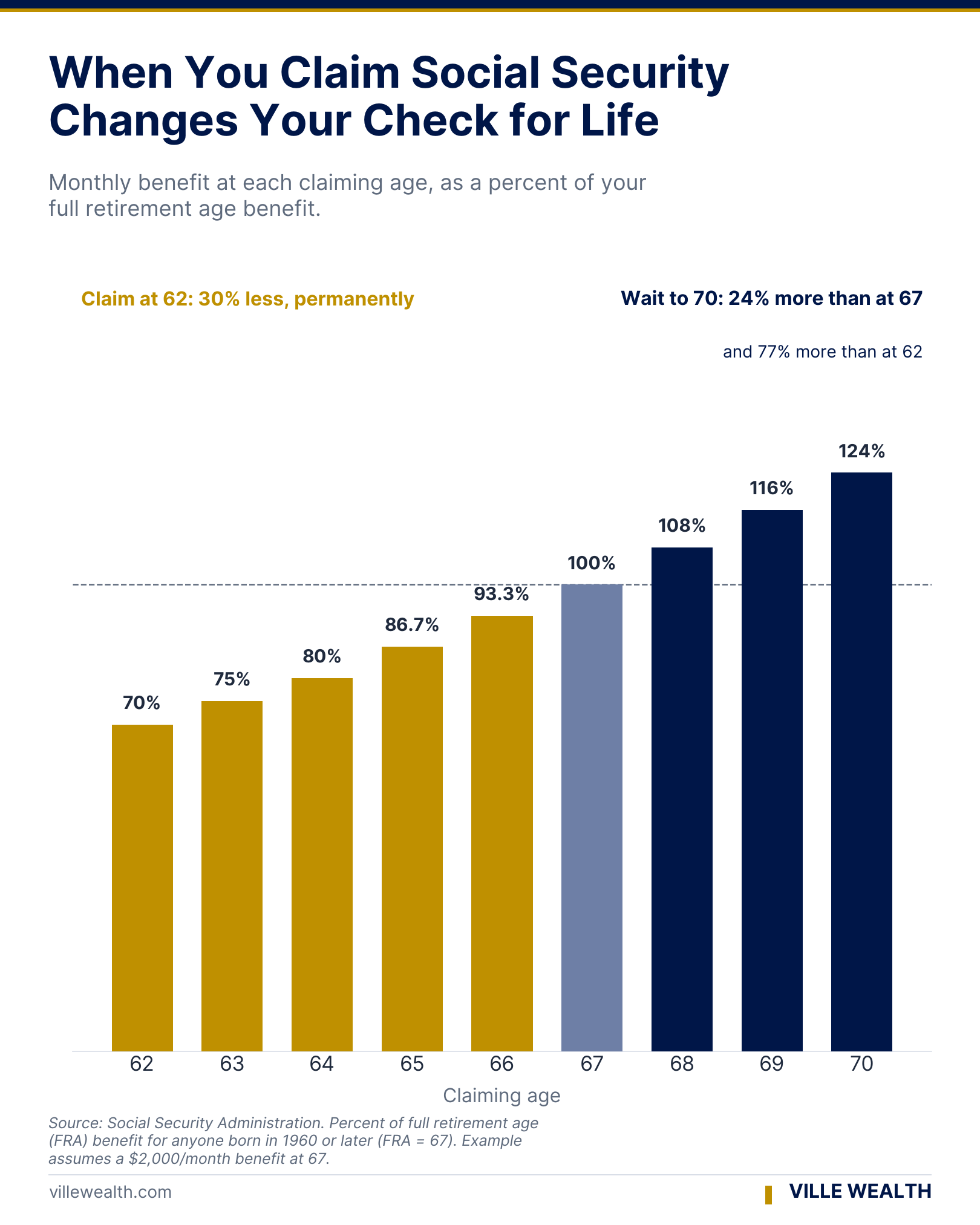
Claiming at age 62 permanently reduces your benefit by up to 30%. Waiting until age 70 increases it by up to 24% compared to your full retirement age benefit. For a married couple, the difference between a good Social Security strategy and a poor one can easily exceed $100,000 in lifetime benefits.
The right answer depends on your health, your spouse's benefit, your other income sources, your tax situation, and how long you plan to work. There is no universal answer — there is only the right answer for your specific situation.
At Ville Wealth Management we model every Social Security scenario for our clients — including spousal coordination strategies, voluntary suspension, survivor benefit strategies, and the tax impact of different claiming ages — before making a recommendation.
Read more: Social Security Timing — When Should You Claim? | How to Apply for Social Security | Social Security Claiming Basics 2026
2. Medicare — Enrollment, Plan Selection, and IRMAA
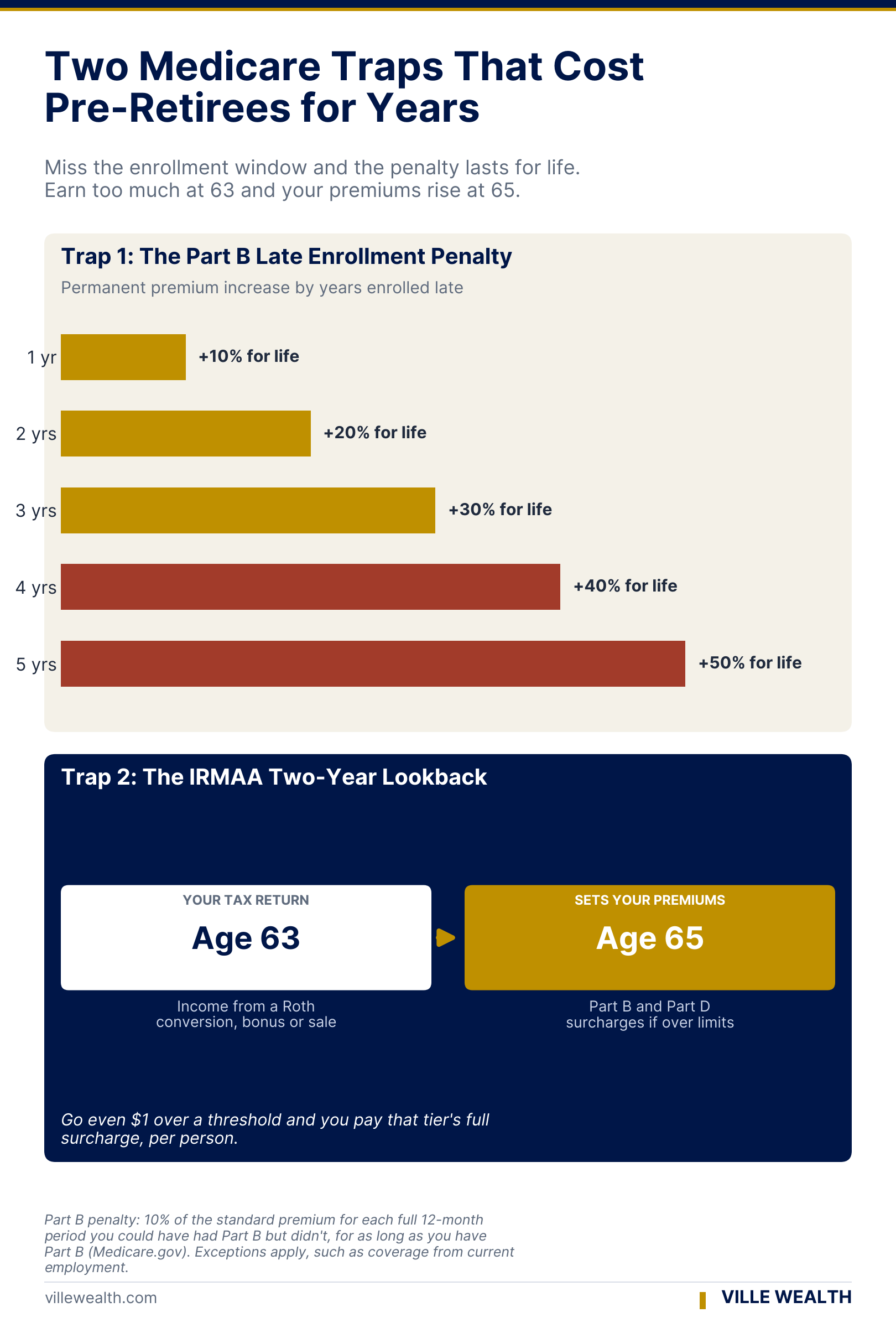
Medicare enrollment has strict deadlines — and missing them results in permanent premium penalties that follow you for the rest of your life. Missing the Part B enrollment window adds 10% per year to your premium, permanently.
Beyond enrollment timing, you face a complex set of plan decisions: Original Medicare vs. Medicare Advantage vs. Medicare Supplement. Each has tradeoffs in premium cost, coverage breadth, network restrictions, and out-of-pocket exposure.
And if your income exceeds certain thresholds — known as IRMAA (Income-Related Monthly Adjustment Amount) — you will pay significantly higher Medicare Part B and Part D premiums. For high-income pre-retirees, strategic income management in the years before Medicare eligibility can save thousands in premiums annually.
Ohio public employees on STRS or OPERS face an additional layer of complexity — your employer coverage and Medicare coordination require careful planning that most advisors miss entirely.
Read more: Medicare Options if Working Past 65 | STRS Ohio and Your Retirement | OPERS and Your Retirement | Plan for Medicare by Age 62
3. The Opportunity Valley: Filling Low Tax Brackets Before RMDs
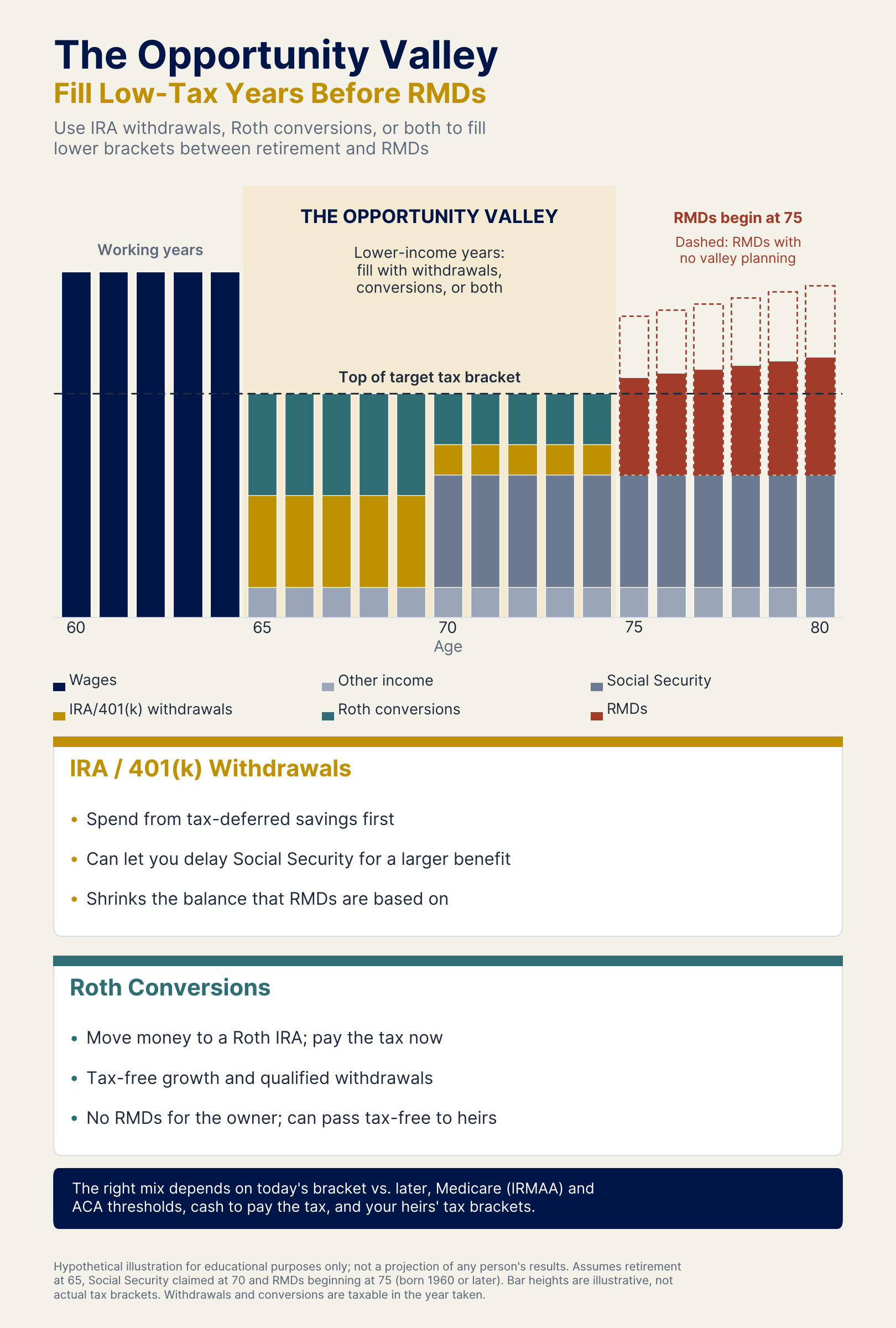
Between your last paycheck and your first Required Minimum Distribution (age 75 for anyone born in 1960 or later), your income and tax bracket often drop to the lowest they'll ever be. We call this the Opportunity Valley. The goal is to use those low brackets on purpose instead of leaving them empty.
There are two ways to fill them:
IRA or 401(k) withdrawals: Strategically withdraw pre-tax money now, at lower tax rates. This shrinks future RMDs and can help you delay Social Security toward age 70 for a larger benefit.
Roth conversions: Pay the tax now so the money can grow tax-free, with no RMDs and tax-free money for your heirs. Conversions work best if you can pay the tax from savings outside the IRA and expect a long retirement.
Roth conversions aren't for everyone. Withdrawals, or a mix of withdrawals and conversions, are often the better fit. Either way, the amount you take each year has to be managed so it doesn't trigger IRMAA surcharges, reduce ACA subsidies, or make more of your Social Security taxable.
We model both strategies side by side for every client and update the plan each year.
Read more: Should You Convert to a Roth IRA? | The HSA Shoebox Strategy | Opportunity Valley: Avoid Large Tax Bills in Retirement
4. Withdrawal Strategy — Which Account Do You Spend First?
Most retirees spend down their accounts in the wrong order — and pay far more in taxes than necessary as a result.
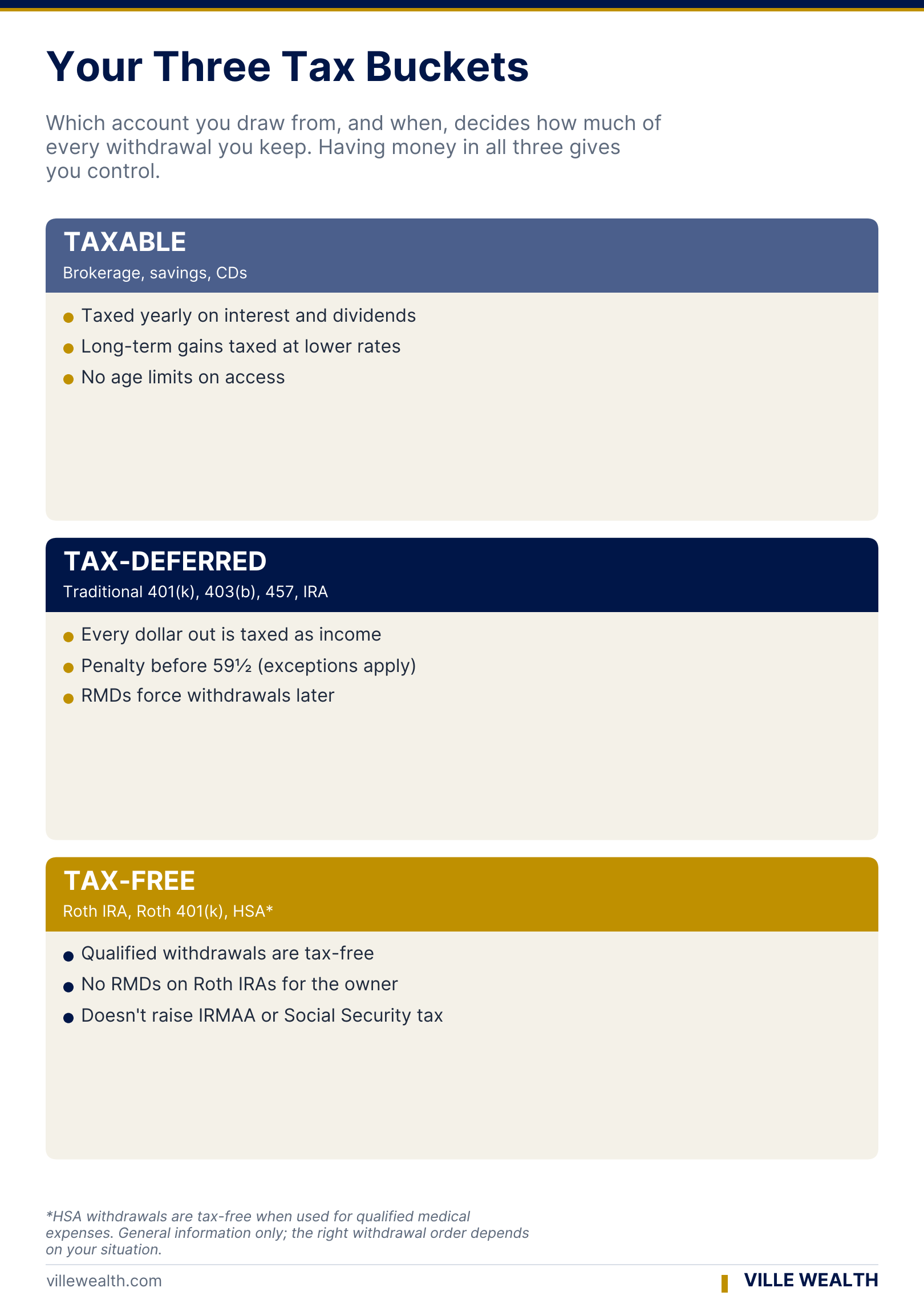
The sequence in which you draw from taxable accounts, traditional IRAs and 401(k)s, and Roth accounts has a profound effect on your lifetime tax bill, your Medicare premiums, and how long your money lasts. A well-designed withdrawal sequence can extend the life of your portfolio by years.
We model your complete withdrawal strategy as part of every client's financial plan — including the interaction between withdrawals, Social Security income, Roth conversions, and Medicare premiums across a 30-year retirement horizon.
Read more:
Opportunity Valley: Avoid Large Tax Bills in Retirement |
Pre 59 ½ IRA Withdrawals Penalty Free -72(t) Strategy | Retirement Hack - Rule of 55
5. Investment Management — Built for the Retirement Transition
For pre-retirees, investment management is not just about returns. It is about not running out of money.
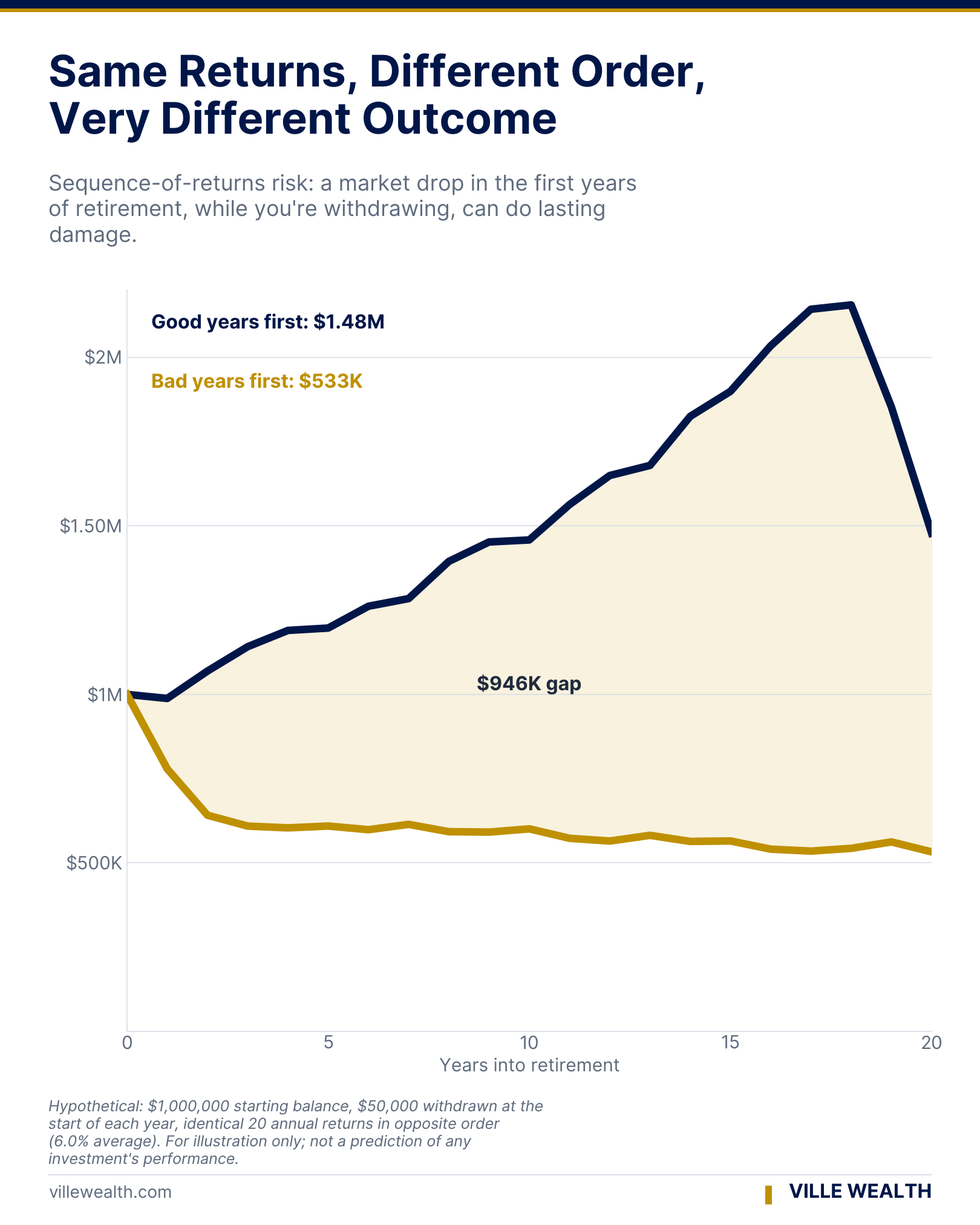
The decade before and after retirement is when sequence-of-returns risk is highest. A significant market decline in the first few years of retirement — combined with ongoing withdrawals — can permanently impair a portfolio that might otherwise have recovered fully given time.
At Ville Wealth Management, we structure client portfolios specifically for this transition:
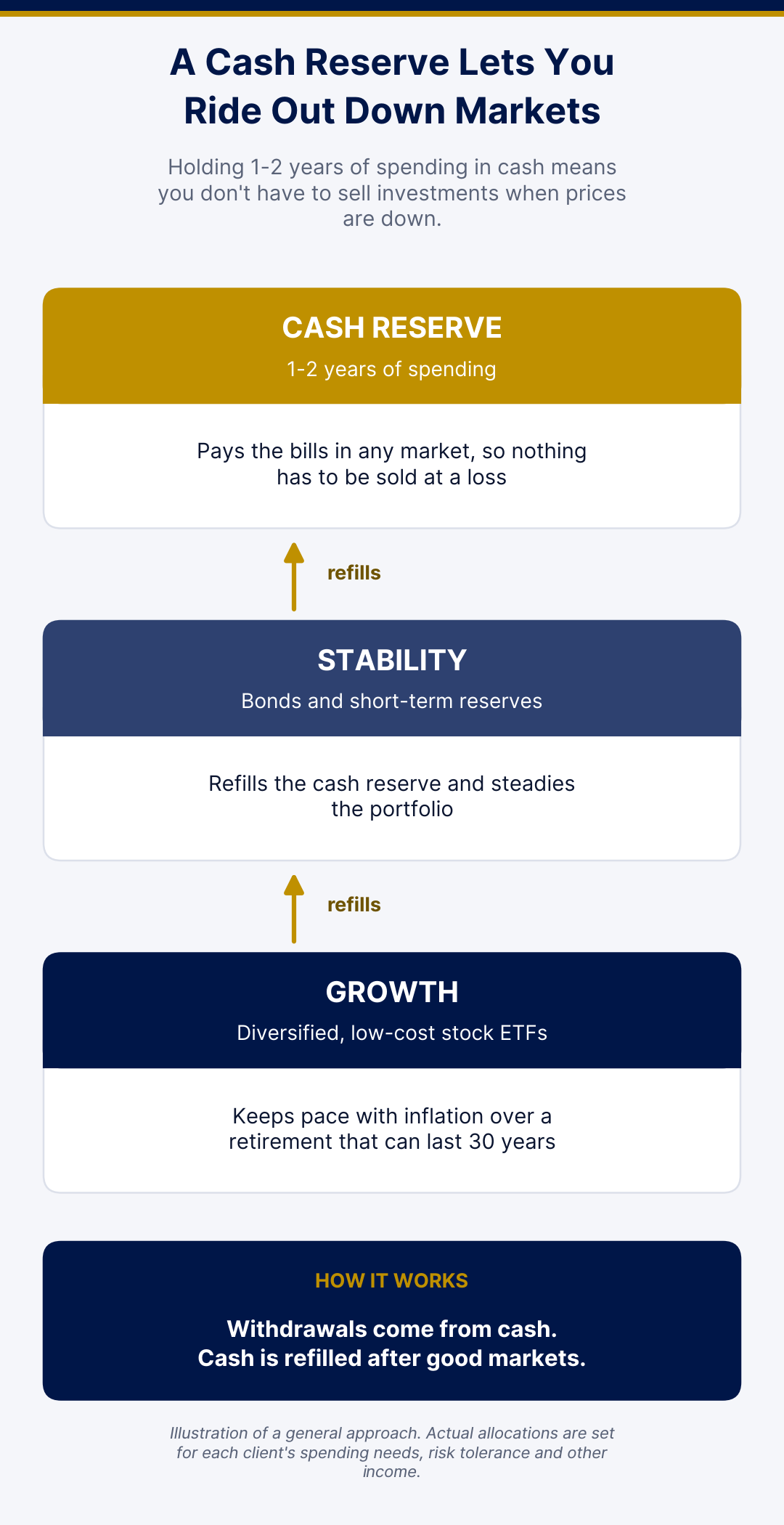
Enough cash for 1-2 years of spending — so you never have to sell investments at the worst possible moment. Most bear markets last nine to ten months. Cash is your insurance policy.
Low-cost, broadly diversified ETFs from Vanguard, iShares, and SPDR — keeping fund expenses as close to zero as possible
A fee of 0.88% or less — while many firms charge 1.4% in advisory fees plus 0.60% in fund expenses totaling nearly 2%, our all-in cost is 0.92% or less (See Our Full Fee Schedule)
Automated real-time rebalancing triggered when asset class drift thresholds are exceeded and when new cash enters your account - not on a fixed quarterly schedule.
Direct indexing in taxable accounts for qualifying clients — enabling tax-loss harvesting and tax-sensitive rebalancing throughout the year
All assets custodied at Altruist — a regulated, SEC-supervised custodian
Read more:
Market Volatility Investment Strategies |
Think Your Index Fund Avoids Concentration Risk? |
Ten Reasons You Need Risk Management

6. Tax Planning — Proactive, Not Reactive
Most advisors review your taxes after the fact. We plan them before they happen.
Effective retirement tax planning for pre-retirees in their 50s and 60s involves:
Roth conversion analysis — how much to convert each year to minimize lifetime taxes
Withdrawal sequencing — which accounts to tap first, second, and third
IRMAA management — keeping income below Medicare surcharge thresholds
Social Security tax minimization — up to 85% of your Social Security benefit can be taxable depending on your other income
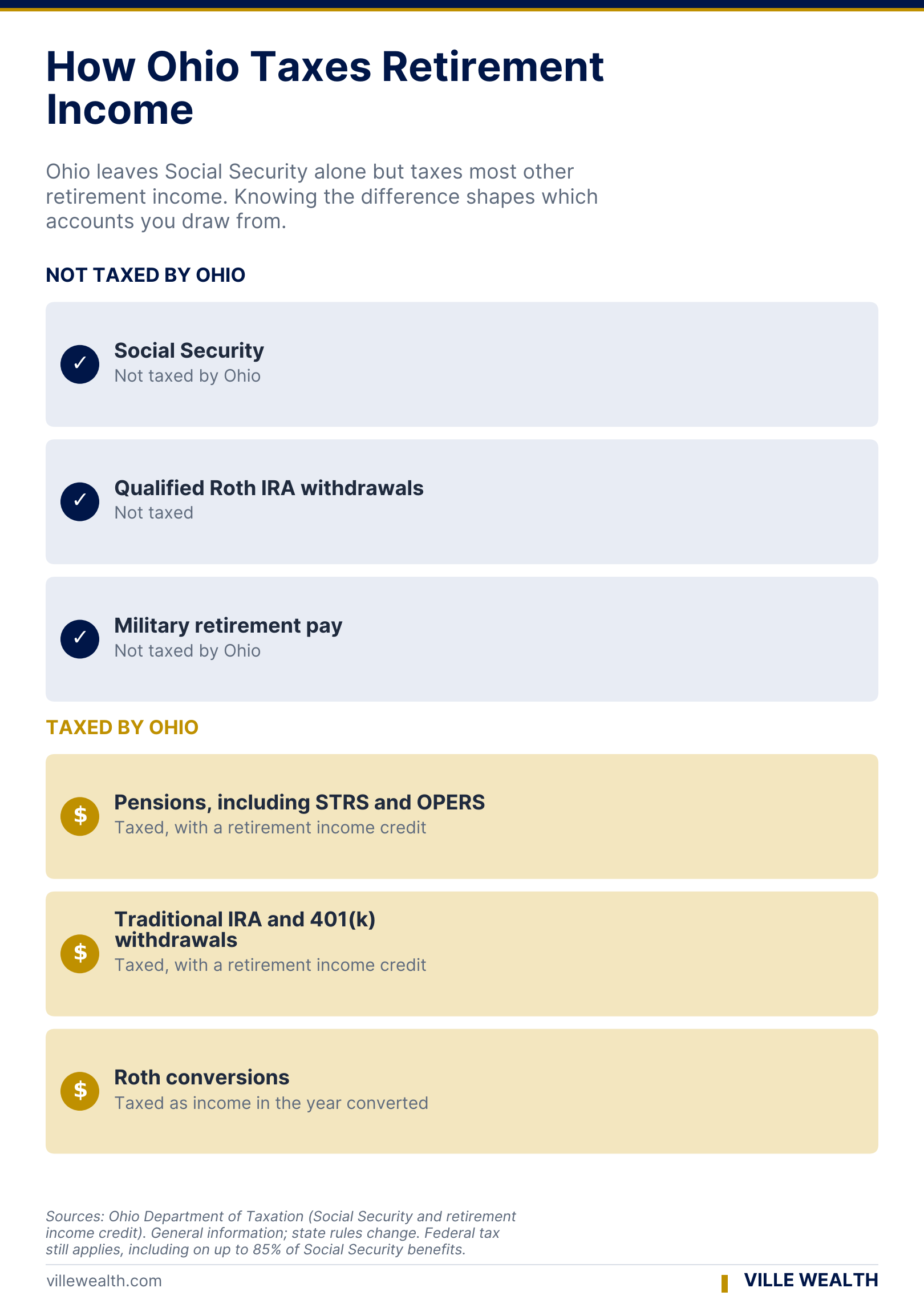
Ohio-specific planning — Ohio does not tax Social Security income and provides a retirement income credit for qualifying taxpayers. Understanding what Ohio does and does not tax can meaningfully affect your net retirement income
Read more: The HSA Shoebox Strategy — A Tax Planning Tool Most Advisors Miss | Opportunity Valley: Avoid Large Tax Bills in Retirement | Pre 59 ½ IRA Withdrawals Penalty Free -72(t) Strategy | Retirement Hack - Rule of 55 | Leftover 529 Money & 529 Plan Hacks
7. Estate Planning — Control, Not Just Documents
Estate planning for pre-retirees is not about death. It is about control.
Who makes financial and medical decisions if you cannot? Are your beneficiary designations current — after a divorce, a remarriage, a death in the family, or a child's changed circumstances? Does your trust actually hold the assets it was supposed to hold? Does your will reflect your current wishes?
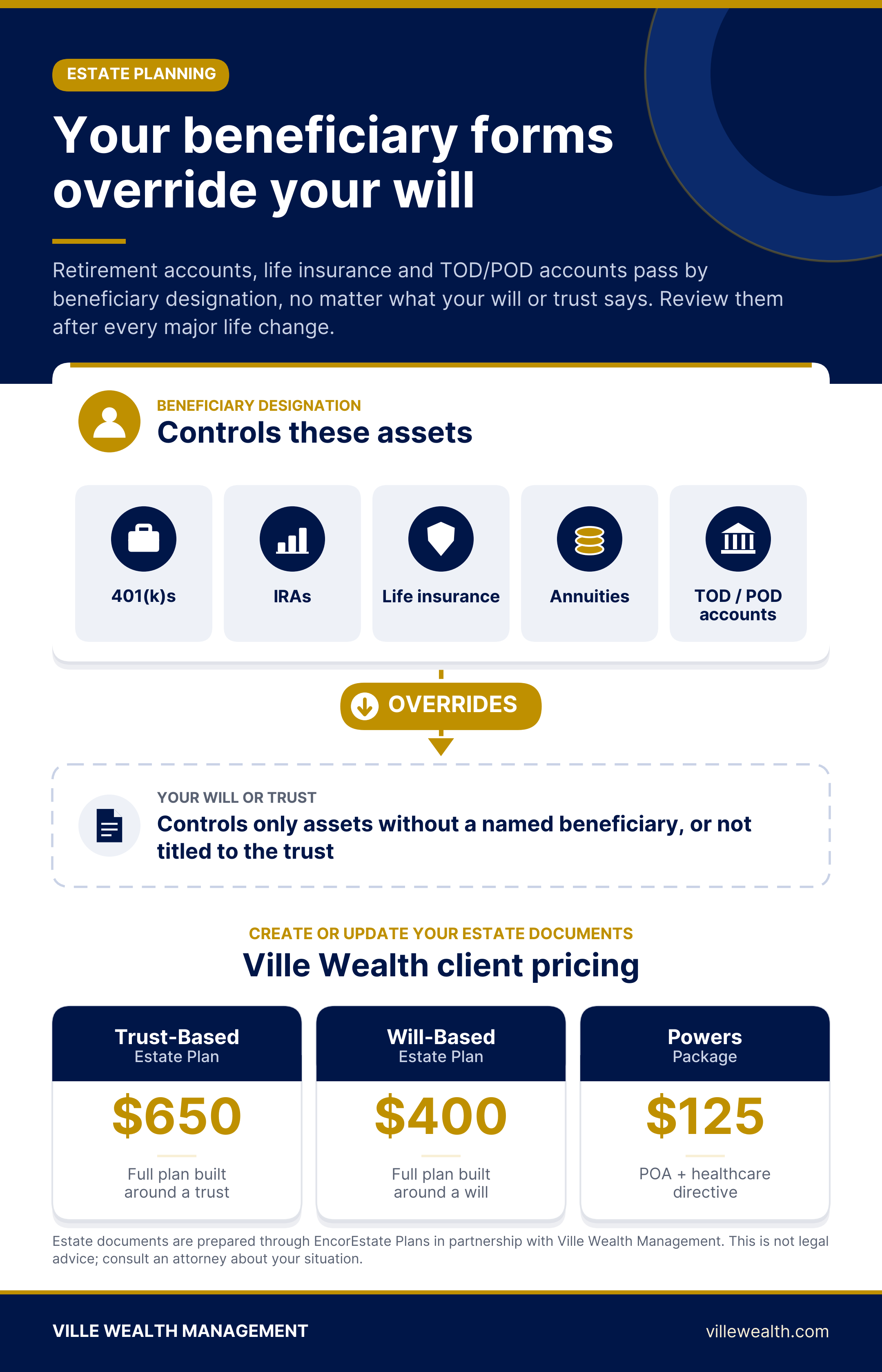
Mismatched beneficiary designations are one of the most common and costly mistakes we see in this age group. They override wills and trusts entirely — and can send assets to the wrong person regardless of what your other documents say.
At Ville Wealth Management we review every client's estate documents, beneficiary designations, and asset titling as part of their annual financial review. We partner with EncorEstate Plans to help clients create or update estate documents at a fraction of typical attorney fees:
Trust-Based Estate Plan: $650
Will-Based Estate Plan: $400
Powers Package (POA + Healthcare Directive): $125
Read more: 10 Important Asset Titling Questions | 10 Strategies for Caring for an Aging Parent
8. Pension and Employer Benefit Decisions — Get These Right Before You Leave
For clients with pensions — including Ohio public employees on STRS or OPERS — the decisions you make at retirement are permanent and irreversible.
Lump sum or monthly annuity? Single life or joint-and-survivor? Which survivor benefit percentage? These choices cannot be undone once made, and the wrong answer can cost your surviving spouse significantly.
We model every pension scenario for our clients — including the interaction between your pension, your Social Security benefit, your other accounts, and your tax situation — before you sign anything.
Read more:
Your Company Pension Before You Retire |
STRS Ohio and Your Retirement |
OPERS and Your Retirement

Who We Are
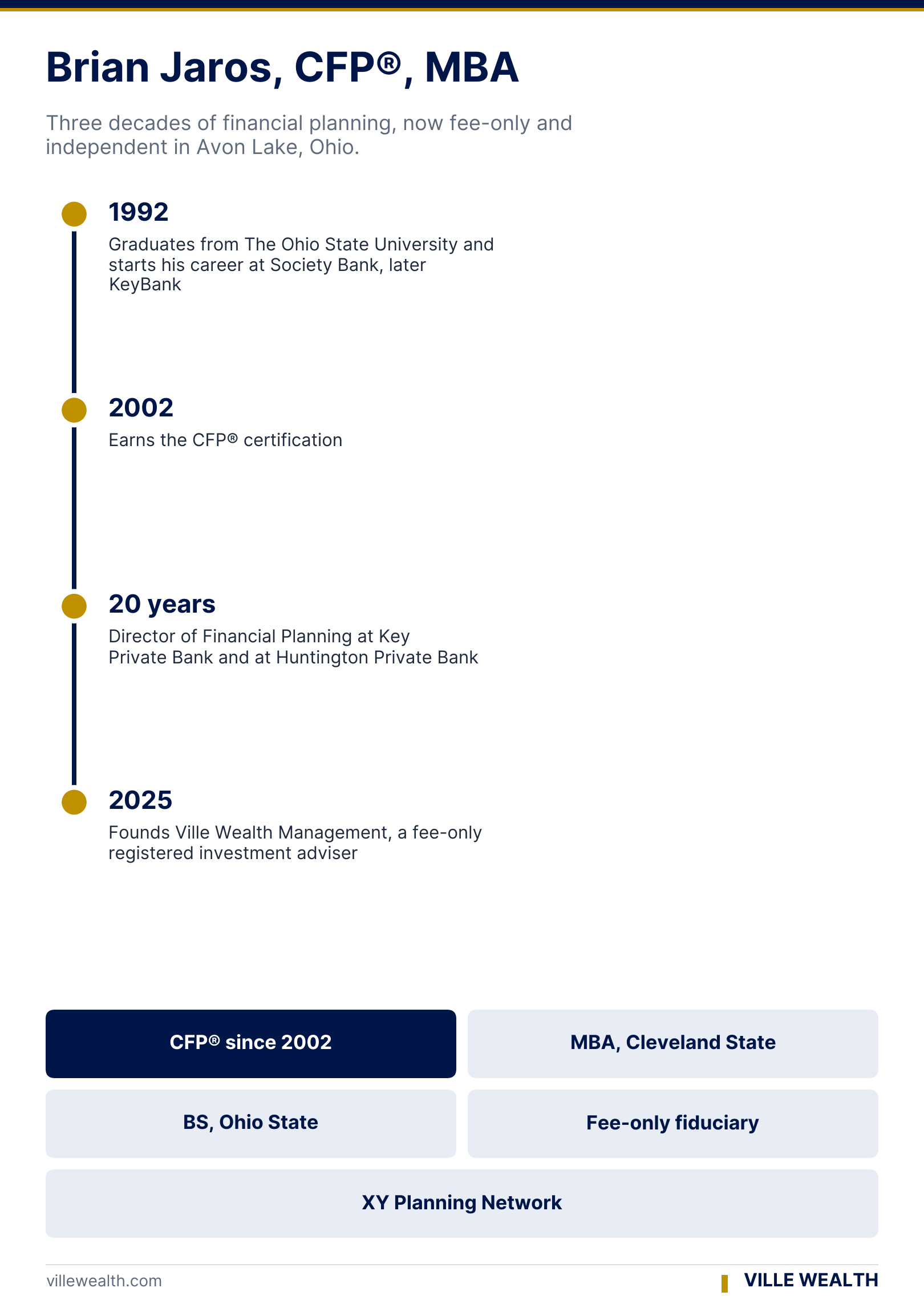
Brian Jaros, CFP®, MBA is the founder and CEO of Ville Wealth Management, a fee-only registered investment advisory firm in Avon Lake, Ohio.
Brian began his financial planning career in 1992 at Society Bank — later KeyBank — and spent the next three decades in financial services. He earned his MBA from Cleveland State University, achieved his CFP® designation in 2002, and spent 20 years building two of the leading financial planning teams at regional private banks — serving as Director of Financial Planning at both Key Private Bank and Huntington Private Bank.
In 2025 Brian founded Ville Wealth Management to return to what he does best: sitting across from clients, understanding their goals, and building retirement plans that are fully implemented. The firm is named after the "Ville" — the close-knit small town in southeastern Ohio where Brian grew up, built on hard work, trust, and people who show up for one another.
Credentials:
CFP® — CERTIFIED FINANCIAL PLANNER™ since 2002
MBA — Cleveland State University
BS — The Ohio State University, 1992
Registered Investment Adviser — Ohio and Texas
Member — XY Planning Network
Listed — CFP Board, Fee Only Network
How Ville Wealth Management Helps With Every Decision
Each of the 8 retirement decisions above has its own dedicated planning service at Ville Wealth Management — included in your advisory fee at no extra charge.
Financial Planning — Your personalized written plan built across all 11 disciplines and fully implemented
Healthcare Planning — COBRA, marketplace plans, Medicare enrollment, IRMAA avoidance, and long-term care
Social Security Planning — Maximize your lifetime benefit for you and your spouse (coming soon)
Tax Planning — Roth conversions, withdrawal sequencing, and the Opportunity Valley
Investment Management — Low-cost, evidence-based, built for the retirement transition
Estate Planning — Beneficiary review, asset titling, Partnering with your Estate Attorney and/or EncorEstate plan coordination
Risk Management — Life, disability, long-term care, and property protection
Frequently Asked Questions
When should I take Social Security?
The right claiming age depends on your health, your spouse's benefit, your other income sources, and your tax situation. For most married couples, having the higher earner delay to age 70 while the lower earner claims earlier produces the highest lifetime benefit. We model every scenario for our clients before making a recommendation.
How much do I need to retire comfortably in Ohio?
A common starting point is 25 times your annual spending — the 4% rule. But the right number depends on your Social Security income, any pension, your spending expectations, your health, and how long you plan to work. We build a complete retirement income projection for every client.
What is IRMAA and how does it affect my Medicare premiums?
IRMAA stands for Income-Related Monthly Adjustment Amount. If your income exceeds certain thresholds — based on your tax return from two years prior — you pay higher Medicare Part B and Part D premiums. Strategic income management in the years before Medicare eligibility can help you avoid these surcharges.
Should I do a Roth conversion before retirement?
For many pre-retirees, the years between retirement and age 75 — when RMDs begin — represent a rare window to convert pre-tax money to Roth at a lower tax rate. Whether a conversion makes sense depends on your current and projected future tax brackets, your estate goals, and your Medicare situation. We model this for every client.
What is a fee-only financial advisor and why does it matter?
A fee-only advisor is paid exclusively by clients — no commissions, no referral fees, no product sales. Our only compensation is the advisory fee you pay, which means our advice is never influenced by what earns us money on the side. This is the purest form of fiduciary advice.
How do I know if I need a financial advisor?
If you have $250,000 or more in investable assets and are within 15 years of retirement, the Social Security, Medicare, tax, investment, and estate decisions you face are complex enough that professional guidance will almost certainly pay for itself many times over — in taxes saved, mistakes avoided, and confidence gained.
What does it cost to work with Ville Wealth Management?
Our fee is 0.88% or less per year on assets under management with a $250,000 household minimum. Included at no extra cost: a personalized written financial plan, full implementation, annual plan reviews, Social Security and Medicare guidance, estate planning review, and investment management.
Ready to Find Out If Your Retirement Plan Is on Track?
The first step is a complimentary introductory meeting -- no cost, no obligation, and no sales pitch. We will get to know each other, take an honest look at where your retirement plan stands, walk through what Ville Wealth Management does and what it costs, and together determine whether moving forward makes sense for both of us.

Schedule Online
Ville Wealth Management LLC is a registered investment adviser in the State of Ohio and Texas. This guide is for informational purposes only and does not constitute personalized financial, tax, legal, or investment advice.